
Sharp-capped pholiota
Hypholoma acutum
Description
Symptoms
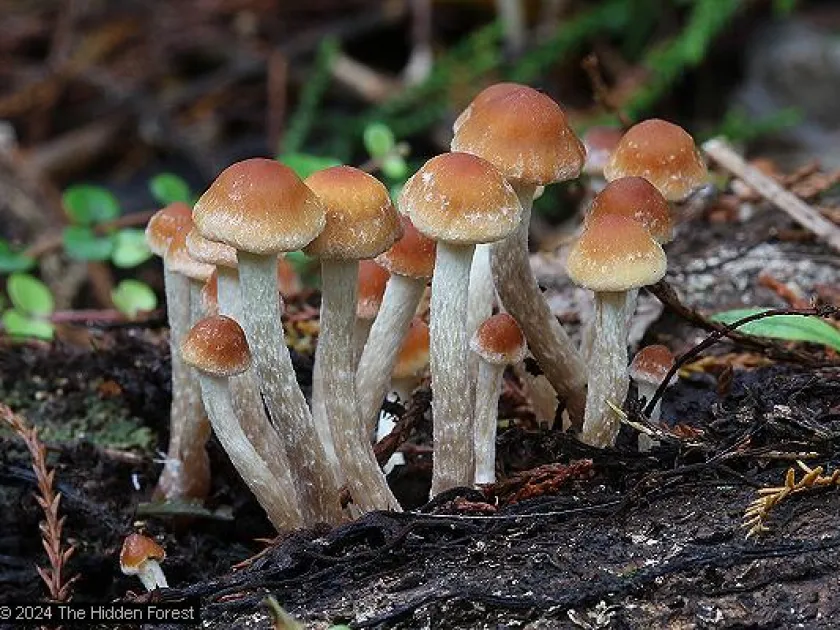
The most visible sign of infection is the emergence of clusters of fruit bodies directly on the trunks, stumps, or at the base of the roots of the affected tree. The sharp conical caps are highly characteristic of this species.
Internally, the infected wood undergoes white rot, losing its structural integrity. Visually, the wood becomes lighter in color, porous, and brittle, often displaying distinct dark demarcation zones within the decaying tissue.
The tree's canopy often shows symptoms of general physiological decline, such as premature yellowing of leaves, wilting of individual branches, and a noticeable reduction in annual shoot growth.
Under the bark in infested areas, one may find white, string-like mycelial cords that penetrate the cambium layer. This vegetative growth effectively cuts off the tree's vascular system, leading to further decline.
In the final stages of the disease, the tree loses its structural stability, often resulting in windthrow or trunk breakage during severe weather, as the root system is structurally compromised by the fungal activity.
Pathogen
The causative agent is the fungus Hypholoma acutum, which belongs to the Strophariaceae family. In mycological classification, this organism acts as a xylotrophic saprophyte that develops primarily on decaying wood of deciduous and coniferous species.
Biologically, it is a fungus whose mycelium colonizes dead or weakened wood. Although typically a saprophyte, under favorable conditions, it can spread to the root systems and trunks of live trees if they are already compromised by mechanical injury or physiological stress.
The fungus produces distinctive fruit bodies with sharp, conical caps, which is the primary morphological identifier for the species. The mycelium aggressively breaks down lignin and cellulose, contributing to the rapid decomposition of woody plant substrates.
Reproduction occurs via spores, which are disseminated by wind or insects over significant distances. Upon reaching cracks in the bark or fresh wounds on trees, the spores germinate, establishing new colonization sites within the wood tissue.
While the fungus serves an ecological role as a decomposer, its presence in managed orchards is viewed as a significant biosecurity risk that requires professional management and sanitation.
Conditions for development
High humidity and poor air circulation are the primary drivers of Hypholoma acutum development. The fungus thrives in shaded, damp microclimates, especially where tree density is too high.
The presence of abundant decaying organic matter, such as stumps, fallen branches, and general orchard debris, provides an ideal substrate for the growth of the fungus and subsequent fruit body production.
Mechanical damage to trunks, whether from agricultural machinery, pruning tools, or pests, provides direct entry points for spores to infect the tree's internal vascular tissues.
Temperature ranges between 15°C and 25°C are optimal for mycelial growth. In these conditions, the fungal lifecycle accelerates, leading to more frequent and intense sporulation events that increase the risk of infection.
Dense planting schemes that prevent the bark from drying out after rainfall create an environment where the fungus can easily maintain its colony and spread to adjacent healthy trees.
Why it matters
The primary damage caused by this fungus is the structural destruction of wood, which inevitably leads to the death of the tree. By breaking down the cellulose, it renders the tree unable to transport nutrients effectively.
Economic damage manifests as the premature loss of fruit-bearing trees, requiring costly removal and replacement procedures that disrupt the long-term productivity of the orchard.
Infected wood loses all market and utility value, as it becomes brittle and porous, making it useless for construction or any functional application in timber production.
The ability of the fungus to release large quantities of spores poses a constant threat to neighboring healthy trees, potentially leading to localized outbreaks that can devastate an entire orchard block.
Long-term infestation reduces the overall resilience of the orchard, leaving the trees vulnerable to secondary infections and secondary pest attacks that exploit the weakened condition of the plant.
Protection
The most effective strategy is strict orchard sanitation. Regular removal of stumps, dead wood, and debris eliminates the food source necessary for the fungus to persist and thrive.
All mechanical wounds on trees must be treated immediately with pruning sealers or specialized disinfectants to create a protective barrier against fungal colonization.
Maintaining tree vigor through balanced nutrition and appropriate watering is essential. A healthy, strong tree is far more capable of compartmentalizing infections and resisting colonization compared to a stressed tree.
If fruit bodies are spotted, they should be mechanically removed and destroyed immediately to prevent spores from spreading across the area and causing new infections.
- Regular inspection of tree trunks for fungal fruit bodies.
- Timely sanitary pruning and removal of diseased branches.
- Proper disposal (burning) of infested wood material.
- Monitoring of orchard microclimate to reduce humidity around trunks.
Discussion
No discussions yet — be the first.