
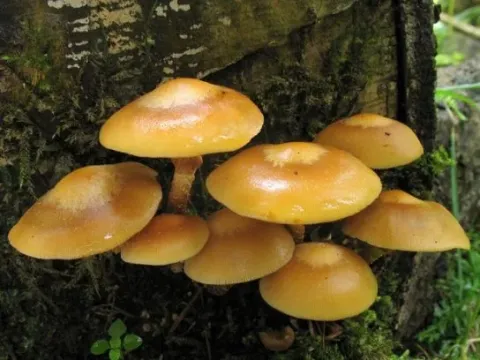
Sheathed woodtuft
Kuehneromyces mutabilis
The sheathed woodtuft (Kuehneromyces mutabilis) is a wood-decaying fungus belonging to the Strophariaceae family. In forestry and arboriculture, it acts as a facultative parasite that causes white rot in deciduous trees.
What the section contains
Sheathed woodtuft
The pathogen spreads through basidiospores that are dispersed by wind or insects, entering the host tree through bark wounds, frost cracks, or improper pruning cuts.
Once inside, the mycelium colonizes the wood, breaking down lignin and cellulose components, which results in the progressive structural decay of the trunk and roots.
The fungus functions primarily as a saprotroph on dead wood but readily transitions to a parasitic phase when it encounters weakened or stressed trees.
The development of fruit bodies in dense clusters on the surface of the bark is a clear indicator that the fungus has successfully established itself within the tree's internal tissues.
A primary visual sign of infestation is the emergence of characteristic clusters of mushrooms growing directly from the base of the trunk or on major root structures.
Wood colonized by this fungus becomes soft, spongy, and exhibits a pale, bleached appearance, losing all its natural structural integrity.
Affected trees often show symptoms of decline, such as premature leaf yellowing, thinning of the canopy, and dieback of individual branches due to impaired water transport.
Bark lesions, deep cracks, and areas of tissue necrosis are often observed at the sites where the fungus is actively developing.
Structural failure is common; as the decay progresses into the heartwood, the tree becomes brittle and prone to snapping during high wind events.
The fungus thrives in environments with high humidity and limited airflow, such as dense or poorly managed gardens where moisture levels remain consistently high.
Temperatures ranging between 15°C and 25°C provide the optimal conditions for mycelial growth and the subsequent development of reproductive fruit bodies.
Mechanical damage to the bark, whether caused by maintenance equipment or pests, serves as the primary gateway for spore entry and colonization.
Trees that are already suffering from nutritional deficiencies or environmental stress are significantly more susceptible to infection compared to healthy, vigorous specimens.
The accumulation of woody debris, such as old stumps and logs on the site, acts as a constant reservoir for fungal spores, facilitating local spread.
Kuehneromyces mutabilis causes severe damage by shortening the lifespan of ornamental and fruit trees, leading to economic losses and the loss of mature landscape elements.
The wood decay it induces is irreversible, meaning that once the central heartwood is compromised, the tree’s overall structural stability is permanently lost.
Damage to the root system disrupts the tree's ability to absorb nutrients and water, resulting in stunted growth and eventual death of the entire plant.
The presence of infected trees poses a high risk to neighboring specimens, as the pathogen can easily jump to healthy plants via root contact or airborne spore clouds.
Removing severely infected trees and their stumps is costly and labor-intensive, often requiring extensive site sterilization before replanting is even possible.
The most effective strategy is rigorous sanitation: infected trees should be removed promptly, including the complete extraction of stumps to eliminate the fungal source.
Disinfection of pruning tools after working on infected trees is mandatory to prevent the transmission of fungal spores to healthy parts of the garden.
All pruning cuts should be sealed with appropriate wound dressings to prevent pathogen entry and protect the exposed wood until natural callusing occurs.
Maintaining tree vigor through balanced fertilization and proper irrigation helps bolster the plant's natural defenses against fungal colonization.
Regular site inspections are essential for the early detection of fruit bodies, allowing for swift management of small outbreaks before they become systemic.