
Exidia
Exidia
Exidia is a genus of fungi belonging to the Auriculariaceae family. These fungi are primarily saprophytes, meaning they thrive on dead or decaying organic matter rather than living tissue.
What the section contains
Exidia
While they are common in woodland and garden settings, they do not act as primary pathogens for healthy plants. Instead, they play a crucial role in the ecosystem as decomposers of wood.
The mycelium of Exidia colonizes dead wood by breaking down complex polymers such as lignin and cellulose. This process returns essential nutrients to the soil, supporting forest health.
In agronomic terms, Exidia is not considered a disease that threatens live crops. It is, however, an indicator species that points to the presence of decaying wooden substrates in the environment.
The genus consists of several species, all of which share the biological requirement of high humidity to complete their life cycle and produce visible fruit bodies.
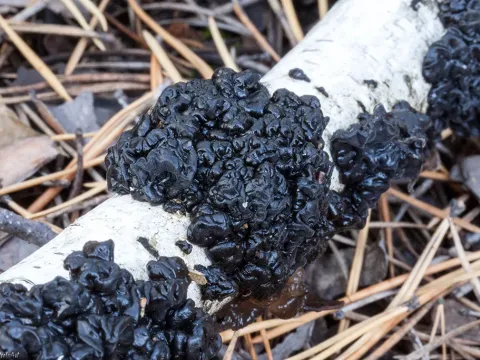
The most visible sign of Exidia is the appearance of gelatinous or rubbery fruit bodies on wood. These can be folded, brain-like, or lobed in shape depending on the species.
Coloration varies significantly, ranging from translucent and whitish to deep brown or black. The texture is often slippery or slimy, especially during periods of wet weather.
These fruit bodies are typically found growing in clusters on dead branches, stumps, or fallen logs of broad-leaved trees. They rarely appear on healthy, living bark.
During dry conditions, the fruit bodies may shrivel into a hard, inconspicuous crust on the wood surface, making them harder to detect until moisture returns.
Frequent occurrence of these fungi on specific trees suggests that the wood has high moisture content and is in an advanced stage of internal degradation.
Exidia development is heavily dependent on moisture. High humidity and rainfall are essential for the expansion and maturation of the fungal fruit bodies.
Shaded, cool, and damp environments are ideal for the growth of Exidia. Sunlight and wind exposure help keep wood dry, which naturally inhibits the colonization by these fungi.
Peak activity typically occurs during spring and autumn when moderate temperatures and consistent rainfall provide the necessary environmental balance.
The presence of decaying organic matter, such as old stumps or fallen debris, acts as a reservoir for spores, facilitating the spread of the fungus when conditions are right.
Proper airflow in a garden or orchard is a critical factor in preventing the establishment of wood-rotting fungi like Exidia, as it limits the time that wood surfaces remain wet.
Exidia itself does not cause direct harm to living, healthy trees. It colonizes wood that is already compromised by other factors or has reached the end of its functional life.
However, the presence of Exidia can indicate that a branch or trunk is structurally unstable. As the fungus breaks down the wood, it compromises the mechanical strength of the tree.
In managed orchards, seeing such fungi on trees is a warning sign of structural decay. This may necessitate pruning or tree removal to prevent accidental breakage during storms.
The colonization by saprophytic fungi can create an environment that encourages other organisms to settle, which might eventually lead to further decline in the tree's health.
While not a parasite, its activity is a symptom of poor maintenance, specifically regarding the failure to remove dead or diseased wood in a timely manner.
The most effective management strategy is regular sanitation. Removing deadwood, stumps, and fallen branches eliminates the habitat required for Exidia to thrive.
Pruning should be performed during dry weather, and all significant cuts should be treated with appropriate sealants to protect the wound while it heals.
Promoting good airflow throughout the garden or orchard reduces environmental moisture, making the area less attractive to wood-decaying fungi.
Regular monitoring of tree health allows for the early identification of dead or dying branches, which should be removed before they become colonized by fungi.
Overall garden hygiene, including the removal of organic debris, reduces the spore load in the environment and helps maintain a healthier growing space for trees.