
Evernia
Evernia
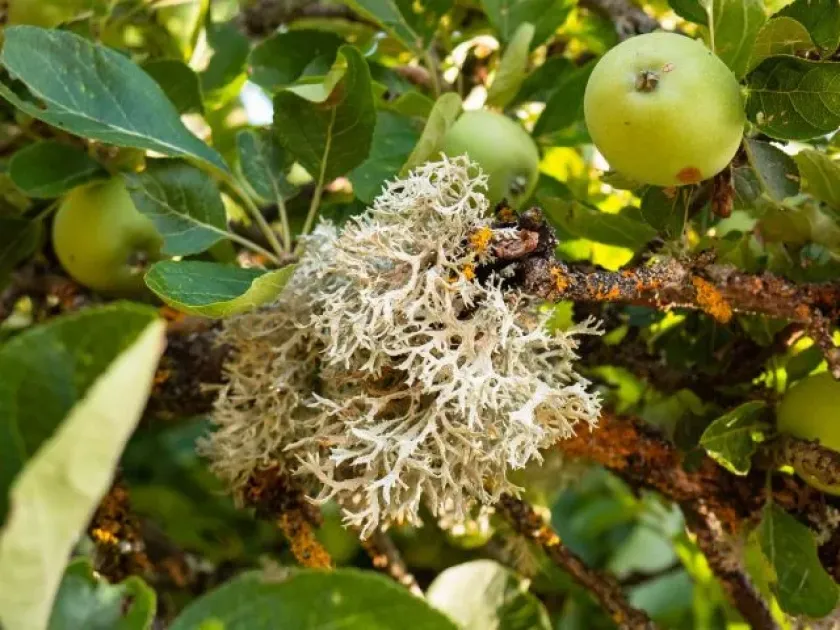
Description
Symptoms
Evernia is a genus of fruticose lichens that often grow on the bark of fruit and forest trees. They are characterized by their bushy, branched thalli that can be greenish-grey or yellowish in color, often resembling small, delicate mosses.
The primary sign of their presence is the appearance of soft, hanging, or upright growths attached to the branches or trunk. Unlike parasitic fungi, they do not infiltrate the living wood but simply use the bark as a surface for attachment.
In cases of heavy colonization, branches can be completely covered by these lichen "beards," which trap moisture and prevent the bark from drying out properly after rain or dew.
A visual inspection of the bark beneath the lichen often reveals a darker, moister surface. This moisture-retaining capacity is the most significant observable impact of the lichen on the tree's exterior.
The distribution of Evernia often follows the density of the canopy; it is most abundant on the shaded, northern sides of branches where humidity remains consistently higher throughout the day.
Pathogen
Evernia is not a plant pathogen in the traditional sense. It is a symbiotic organism consisting of a fungus and an alga. As an epiphyte, it does not derive nutrients directly from the tree's sap or tissues.
The lichen relies on the atmosphere for nutrients, absorbing dust, minerals, and moisture from the air and precipitation. The fungus provides structural support and protection, while the alga provides energy via photosynthesis.
Reproduction occurs through the dispersal of small vegetative fragments of the thallus or through fungal spores. These are carried by wind or birds to new locations on the tree bark, where they establish new colonies.
From an ecological perspective, Evernia is a sign of good air quality, as it is highly sensitive to pollutants like sulfur dioxide. However, in an agricultural setting, it is often seen as a indicator of poor maintenance.
The organism does not actively destroy healthy tissue, but its presence can be a symptom of a slow metabolic rate in the tree, which prevents the regular shedding of outer bark layers.
Conditions for development
High humidity and poor ventilation within the tree canopy are the primary conditions that favor the rapid growth of Evernia. Dense, unpruned crowns create the perfect stagnant environment for colonization.
Mature trees with rough, aged bark provide a superior anchor point compared to young, smooth-barked trees. The presence of cracks and crevices on old bark helps the lichen establish a foothold more securely.
Low light levels in the interior of the tree crown prevent the bark from drying quickly, ensuring the lichen has the consistent moisture it needs for metabolic activity.
Gardens situated in valleys, near forests, or in regions with high average annual rainfall are naturally more prone to having trees covered in Evernia.
The lack of proper orchard management, such as the failure to clear away dead wood or thinning out dense branches, directly leads to the accumulation of lichen populations.
Why it matters
While not a parasite, Evernia can indirectly harm the tree by obstructing the lenticels (pores in the bark). This interference reduces the bark's ability to facilitate gas exchange, essentially hindering the tree's "breathing."
The lichen layers act as a shelter for various insect pests, including scales and mites, which hide beneath the bushy growth to escape predators or pesticides.
Moisture trapped by the lichen creates a hospitable environment for true fungal pathogens to develop and infect the bark, leading to rot and structural damage.
In cases of extremely dense growth, the added weight of the lichen during winter (especially when covered in frost or snow) can increase the risk of branch breakage.
Beyond physical damage, the presence of heavy lichen cover is an aesthetic indicator of an uncared-for orchard, which may affect the perceived value of the crop or the land.
Protection
The most effective strategy for control is consistent canopy management. Annual pruning to remove diseased, dead, or excessive branches improves air circulation and light penetration, making the environment unsuitable for lichen.
Mechanical removal is highly effective. Using a stiff-bristled brush or a specialized scraper during the dormant season allows for the removal of existing colonies without damaging the live cambium layer.
Chemical control can be achieved by applying a 1–3% solution of copper sulfate to the trunks and main branches. This treatment kills the lichen and helps disinfect the bark surface.
Whitewashing the trunks with a lime-based mixture acts as a preventative measure, creating a high-pH surface that discourages the attachment of lichen spores.
- Maintain tree vigor through proper fertilization to encourage bark renewal.
- Monitor for insect pests that may be hiding under lichen colonies.
- Ensure the orchard site has proper drainage to minimize overall humidity.
- Perform regular inspections of tree health, focusing on the trunks and major limbs.
Discussion
No discussions yet — be the first.