
Exidia cartilaginea
Exidia cartilaginea
Exidia cartilaginea is a basidiomycetous fungus belonging to the Auriculariaceae family. In agricultural and forestry terms, it is classified as a wood-decaying saprotroph that thrives on dead or severely weakened wood of broad-leaved tree species.
What the section contains
Exidia cartilaginea
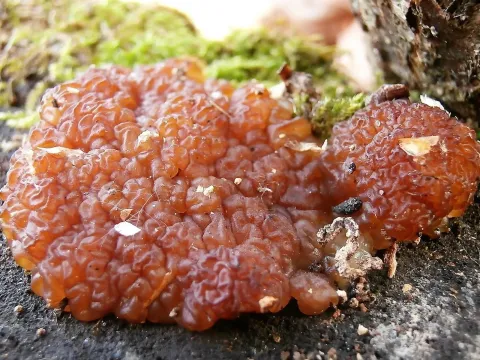
The fungus produces gelatinous, cartilaginous fruiting bodies that vary significantly in shape and size depending on environmental humidity levels.
Biologically, it is involved in the decomposition of lignin and cellulose, playing a crucial role as a decomposer within forest and orchard ecosystems.
While primarily feeding on organic debris, it can colonize damaged sections of living trees if the bark integrity has been compromised.
It is widely recognized by mycologists as a common inhabitant of fallen branches, logs, and damaged trunks in broad-leaved woodlands.
The most prominent sign of infestation is the appearance of translucent, jelly-like fruiting bodies on the bark of the host tree.
During dry spells, the fruiting bodies dehydrate, turning into thin, dark, and inconspicuous films that are difficult to identify without close inspection.
Upon exposure to rainfall, these films rehydrate, swelling back into gelatinous blobs that are typical for the species during moist conditions.
The presence of Exidia cartilaginea is often associated with localized discoloration of the wood, indicating the early stages of structural decay.
Visual observation is most successful on fallen branches or living trees that have suffered from deep cracks, frost damage, or improper pruning cuts.
The development of this fungus is strictly moisture-dependent; high humidity and prolonged wet periods are essential for its growth and spore production.
Shaded, stagnant-air environments are ideal for colonization, as they prevent the rapid evaporation of moisture from the tree bark surface.
Mechanical injuries, such as frost cracks, sunscald, or improper cuts, provide entry points for fungal spores to settle and germinate effectively.
Warm and damp seasons are particularly conducive to the rapid spread of the mycelium across the substrate surface.
Accumulations of leaf litter and dead wood near healthy trees provide a source of inoculum that increases the risk of contamination in orchard settings.
Though primarily a saprotroph, the persistent presence of Exidia cartilaginea on weakened trees accelerates wood degradation and contributes to rot.
The compromised bark provides a gateway for secondary pathogens, which can be significantly more destructive to the health of the host tree.
Gradual damage to the cambium layer weakens the tree, resulting in decreased vitality, reduced yields, and premature limb dieback.
In forest plantations, heavy colonization on young, vulnerable saplings can impede their growth and potentially lead to their death.
Structural integrity is gradually lost, making the affected branches brittle and more prone to snapping during storm events or heavy snowfall.
The primary control measure involves maintaining strict orchard hygiene by timely removing and disposing of dead wood, branches, and infected material.
Promptly treating any mechanical bark injuries with professional-grade sealants or fungicides prevents fungal colonization of exposed tissues.
Pruning trees to ensure optimal airflow within the canopy reduces local humidity levels, creating an inhospitable environment for fungal growth.
Applying copper-based fungicides during spring maintenance can lower the overall spore count in the garden and protect trees from initial infection.
- Regular sanitary pruning of dead or diseased branches.
- Thorough cleaning and sealing of wounds and cavities.
- Proper disposal of infected wood away from healthy plants.
- Ensuring good garden ventilation and sunlight penetration.