
Evernia prunastri
Evernia prunastri
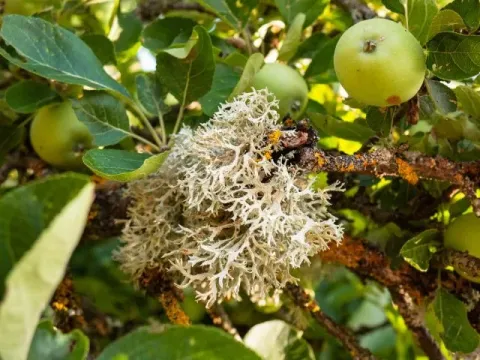
Evernia prunastri, frequently called oakmoss, appears as bushy, branched thalli ranging in color from pale gray-green to deep olive.
What the section contains
Evernia prunastri
The thallus is characterized by a flattened, strap-like structure that clings tightly to the bark, forming dense, spongy mats over time.
In mature colonies, the lichen spreads across large areas of the trunk and branches, creating a distinctive, velvety texture on the tree surface.
The overall appearance of the affected tree changes as the growth obscures the natural patterns and colors of the host bark.
During moist conditions, the lichen becomes more flexible and vibrant in color, while in dry periods, it may appear brittle and faded.
Evernia prunastri is not a disease-causing pathogen but rather an epiphytic lichen formed by a symbiotic relationship between a fungus and algae.
It does not infect the tree tissue or draw nutrients from the host plant, instead, it utilizes the bark solely as a physical substrate for attachment.
The organism captures moisture, nutrients, and minerals directly from the atmosphere, atmospheric dust, and rainwater that flows over the bark.
Its biological cycle is entirely independent of the tree's internal vascular system, meaning it functions as an inhabitant rather than a parasite.
This species is highly sensitive to air quality, and its prevalence often indicates a relatively clean and stable environmental condition.
Successful colonization of tree bark by oakmoss requires high humidity levels and shaded or partially shaded positions.
Older trees with rough, furrowed bark provide the most stable surfaces for lichen spores to attach and begin developing their thalli.
Lack of proper air circulation, often due to neglected pruning, creates a localized microclimate where moisture persists, favoring lichen growth.
Lower light intensity within the canopy allows the lichen to thrive without the risk of desiccation that would occur in direct, intense sunlight.
Slower-growing trees are more susceptible to colonization as their bark does not flake off or shed as frequently as that of younger, vigorous specimens.
While not inherently parasitic, excessive growth of Evernia prunastri can provide a refuge for overwintering pests such as scale insects and mites.
The dense cover of lichen may interfere with the natural gas exchange of the bark, potentially impacting the health of the outer tree layers.
Continuous moisture held by the lichen mats can create a breeding ground for various wood-decay fungi and opportunistic bacterial pathogens.
Heavy infestation is often a secondary indicator that the tree is in a state of physiological decline, necessitating an assessment of overall tree health.
The accumulation of debris and moisture under the lichen layer can eventually lead to superficial bark softening and minor surface deterioration.
The primary method of control is the manual removal of lichen mats using soft-to-medium bristle brushes during periods of high humidity.
Strategic pruning to thin out the canopy is essential to improve airflow and increase sunlight exposure, which naturally inhibits further colonization.
Applying a whitewash made of lime and a small amount of copper sulfate to the trunks acts as a deterrent against lichen spore attachment.
Spraying the trees with ferrous sulfate solutions during the dormant season effectively eliminates existing lichen colonies from the bark.
Promoting tree vigor through balanced fertilization and appropriate irrigation helps the tree maintain healthier bark, naturally resisting significant lichen coverage.