
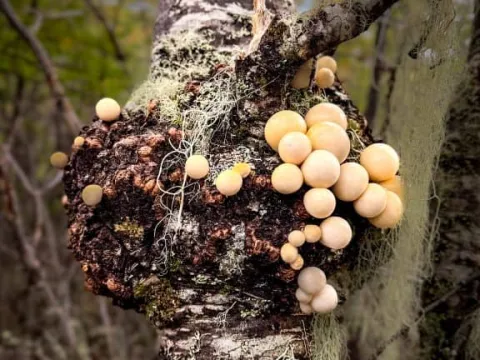
Cyttaria darwinii
Cyttaria darwinii
Cyttaria darwinii is a species of ascomycete fungus within the order Helotiales, known for its parasitic lifestyle on Southern Beech trees.
What the section contains
Cyttaria darwinii
It acts as an obligate parasite, establishing a complex biological relationship with its host, primarily species of the genus Nothofagus.
The fungus manipulates the host's tissue growth, resulting in the formation of woody galls that provide the necessary nutrients for the pathogen.
Its reproductive structures, or ascomata, emerge from the host bark in distinct, brightly colored spherical clusters, often described as berry-like.
The survival of the fungus depends entirely on the presence of living host tissue, making it a specialized pathogen in its native temperate forests.
The most diagnostic sign of infection is the development of distinct, distorted woody galls on the trunks and branches of affected trees.
During the sporulation season, the surface of these galls produces numerous yellowish to orange fruiting bodies, which are easily visible to the naked eye.
As these fruiting bodies mature, they rupture the bark, creating conspicuous open wounds that expose the internal wood of the branch.
Affected branches often exhibit symptoms of reduced vitality, including smaller leaves, chlorosis, and general thinning of the foliage.
Over time, the cumulative damage leads to deep, open cankers that can persist for years, significantly altering the tree's morphology.
The development of Cyttaria darwinii is highly dependent on high moisture levels and a humid forest environment typical of the southern regions.
Frequent rainfall serves as a primary vector for spore dispersal, washing the infectious material into cracks and wounds on the tree bark.
Moderate temperatures during the growing season facilitate the growth of fungal mycelia within the host tissue, promoting gall expansion.
Trees that have already sustained mechanical or environmental stress are generally more susceptible to successful colonization by the fungus.
Dense stands of Nothofagus allow for efficient spore transition between trees, ensuring the persistence of the disease within the forest stand.
The primary impact involves structural weakening of branches, which increases the risk of limb failure under snow load or strong winds.
The parasite competes for nutrients, leading to a significant metabolic drain on the host tree and potentially inhibiting its long-term growth.
The breach of the protective bark layer leaves the tree susceptible to secondary colonization by opportunistic wood-decay fungi and insect pests.
Chronic infection results in severe canopy dieback, reducing the overall photosynthetic capacity of the individual tree.
In forest management, high infection rates diminish the quality of timber and can negatively affect the ecosystem's structural health.
Managing this disease in natural forests is difficult; however, maintaining stand health through proper silvicultural practices is recommended.
Preventive measures include the removal of heavily infected branches or trees to reduce the overall inoculum load in the vicinity.
Monitoring the health of the plantation or forest stand is essential to detect outbreaks early before the fungus spreads to younger trees.
Minimizing mechanical injuries during forest maintenance reduces the number of entry points for fungal spores to colonize healthy tissues.
There are no chemical fungicides widely used in wild forests; therefore, biocontrol and selection for resistant genotypes remain the primary focus.