
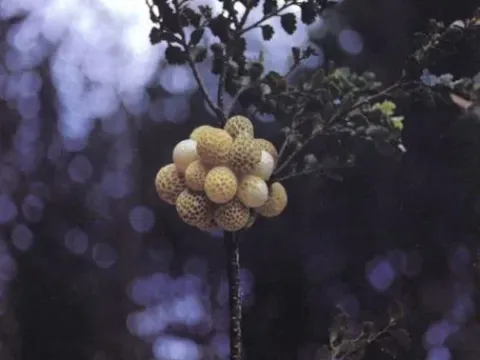
Cyttaria nigra
Cyttaria nigra
The disease is caused by the ascomycete fungus Cyttaria nigra, which acts as an obligate parasite of the Southern Beech tree species (Nothofagus).
What the section contains
Cyttaria nigra
The fungus develops internally within the tree's branches and stems, forming complex mycelial networks that manipulate the host's growth to create galls.
This pathogen has a complex life cycle, spending most of its time as mycelium within the living tissue before producing its characteristic fruiting bodies.
The reproductive organs of the fungus appear annually, emerging through the bark to disperse spores into the environment.
As a highly host-specific fungus, its survival is inextricably linked to the physiological health and growth cycles of its host Nothofagus trees.
The most prominent sign of infestation is the formation of large, woody galls on the stems and branches of infected trees.
During the sporulation stage, visible black, sponge-like or honeycombed fruiting bodies protrude from these galls, often becoming sticky due to spore-laden secretions.
The presence of these galls often disrupts the tree's vascular system, leading to localized wilting and premature yellowing of leaves in affected branches.
Chronic infections cause significant architectural changes, leading to distorted growth patterns and uneven development of the tree canopy.
- Development of large, distinct black galls.
- Distorted and misshapen branch growth.
- Visible honeycombed fungal fruiting bodies.
- Reduced foliage density in infested areas.
Cyttaria nigra thrives in cool, humid temperate environments, which are typical for the natural habitats of Nothofagus forests.
The fungus relies on moisture for spore dispersal and germination, making rainy seasons the primary period for the spread of new infections.
High tree density in native forests increases the rate of pathogen transmission, as spores can be easily carried by wind or raindrops from tree to tree.
The infection rate is often higher in older trees, as they provide a larger surface area and more time for the fungus to establish large, mature galls.
Mechanical stress and small wounds on the bark serve as entry points, facilitating the initial establishment of the fungal mycelium.
The fungus causes long-term physiological stress to the host tree, consuming essential nutrients and causing systemic exhaustion.
Structural integrity of the wood is compromised by the presence of large galls, making the branches susceptible to breaking during high winds.
Infected trees suffer from reduced growth rates, which impacts the productivity and ecological health of the forest ecosystem.
The resulting deformation and weakening of the trees make them more susceptible to colonization by secondary pests and other opportunistic pathogens.
While the disease rarely kills a mature tree rapidly, the cumulative damage over years significantly degrades the overall vitality of the forest stand.
Management of Cyttaria nigra in forest settings is challenging, with current strategies focusing primarily on the removal of heavily infected specimens.
Sanitation practices involving the removal and proper disposal of infested debris can help reduce the local spore load in managed forest areas.
Monitoring programs are essential to detect and manage early-stage infections before they have a chance to sporulate and spread to healthy neighbors.
Maintaining a diverse and healthy forest stand helps reduce the overall susceptibility of the population to high-intensity outbreaks.
Research into selecting potentially resistant genotypes of Nothofagus is considered a long-term solution to mitigate the impact of this fungal disease.