
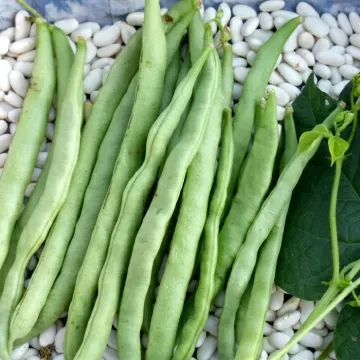
Description
Symptoms
Initial signs of the disease appear on the cotyledons as dark brown lesions that eventually deepen. On leaves, symptoms manifest as small angular spots, often concentrated along the veins, which can cause leaf blade deformation.
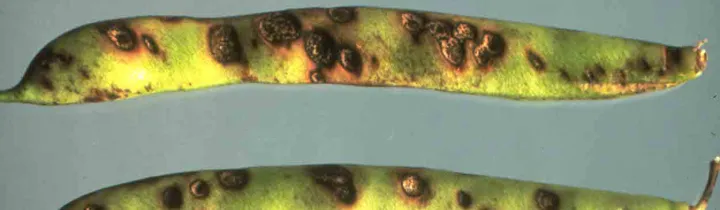
The most characteristic lesions are observed on pods, where deep reddish-brown or black spots with a distinct border are formed. In wet weather, a pinkish mass of fungal spores appears in the center of these lesions.
Infection of stems or petioles leads to elongated lesions, often resulting in plant lodging or death at early growth stages. The internal tissues of affected pods can also be colonized by mycelium, leading to the formation of malformed or underdeveloped seeds.
On seeds, severe infection results in yellowish-brown spots, which may sometimes be sunken. Such seeds act as an inoculum source during the following season, completing the pathogen's development cycle.
Field diagnosis is based on visual inspection; however, if accurate identification of the pathogen species is required, laboratory methods involving isolation on nutrient media followed by microscopy are employed.
Pathogen
The causal agent of the disease is the imperfect fungus Colletotrichum lindemuthianum, belonging to the order Melanconiales. The mycelium of the pathogen can persist in infected seeds and plant debris in the soil for several years, serving as the primary source of infection.
The pathogen's life cycle involves the formation of conidial fruiting bodies known as acervuli, which rupture the host tissue epidermis. Under conditions of high humidity, the fungus actively produces conidia that are disseminated by rain splashes, wind, and insects.
The fungus exhibits significant intraspecific variability, leading to the emergence of new physiological races. This complicates the breeding of resistant bean varieties, as the pathogen is capable of overcoming the plant's genetic defenses.
The mycelium is intercellular and obtains nutrients by secreting enzymes that degrade the host's cell walls. During its life cycle, the pathogen releases toxins that cause tissue necrosis, appearing as characteristic lesions on various parts of the plant.
The fungus primarily infects common beans, but it can also affect other bean species, fava beans, and lupines. The susceptibility of varieties varies greatly, making the selection of high-quality seed material a critical step in disease management.
Conditions for development
Bean anthracnose develops most actively in cool and rainy weather conditions. The optimal temperature range for spore germination is between +15°C and +20°C, and relative humidity must be at least 90–95%.
Prolonged spring rains create ideal conditions for the initial infection of seedlings. During the summer, epiphytotic outbreaks are most often observed after rainfall events accompanied by strong winds that facilitate conidia dispersal.
Excessive planting density creates a microclimate with poor air circulation, increasing the risk of rapid fungal spread within the field. Poor aeration of the canopy contributes to moisture lingering on leaf surfaces for extended periods.
Failure to implement crop rotation, by planting beans in the same field less than 3–4 years apart, leads to the accumulation of infectious inoculum in the soil. Infected plant debris left on the field serves as an ideal substrate for the pathogen to overwinter.
Using low-quality seed material harvested from infected plants is the primary factor in the spread of anthracnose to new areas, even when ideal agronomic practices are followed.
Why it matters
The damage caused by anthracnose includes a drastic reduction in pod yield and a decline in quality. Affected pods lose their nutritional value and become unsuitable for storage, as they rot rapidly.
The disease leads to sparse plant stands due to seedling mortality, which necessitates replanting. This results in additional economic costs for seeds and fuel for repeated field operations.
Decreased photosynthetic activity due to foliage damage weakens the plants, which negatively affects seed filling. Ultimately, the thousand-seed weight decreases significantly, and germination rates drop.
In cases of severe disease progression, yield losses can reach 50% or more, especially in years with a wet summer. In large-scale farming, this represents not only quantitative losses but also significant investments in fungicides for crop protection.
The accumulation of the pathogen in the seed bank makes it impossible to use home-saved seed for future seasons. This limits the farmer's selection of varieties and requires continuous investment in purchasing certified, disease-free seed.
Protection
The primary control method is the use of healthy seed material. Seeds must be harvested only from fields free of anthracnose or undergo prior laboratory testing to detect latent infection.
Adhering to a crop rotation system where legumes are not planted in the same field for at least 3-4 years significantly lowers the infectious background. It is also important to deep-plow crop residues after harvest to accelerate their decomposition.
Agronomic practices, such as maintaining optimal planting density and timely weed control, improve plant aeration and prevent the development of a humid microclimate. Choosing anthracnose-resistant bean varieties is also highly recommended.
Chemical control includes seed treatment with fungicides before planting. During the growing season, at the first signs of disease, systemic fungicide sprays based on copper, mancozeb, or other effective active ingredients against Colletotrichum species are applied.
Regular phytosanitary monitoring of fields allows for the early detection and containment of disease hotspots. Applying preventive treatments before conditions favorable to the fungus occur helps to minimize yield losses.
Content graph
Connections · Bean anthracnose
Most often together:
Marketplace
Products · 14


Community
Discussion
No discussions yet — be the first.