
Armillaria root rot
Armillariella mellea
The first external sign of the disease is stunted growth, premature yellowing and dropping of leaves, and reduction in fruit size. The canopy gradually thins, and branches begin to die back systematically from the periphery inward.
What the section contains
Armillaria root rot
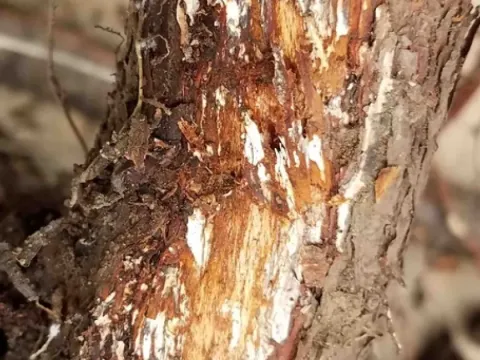
Beneath the bark at the lower stem and on large roots, distinct white mycelial fans are visible. The affected wood tissue softens and acquires a characteristic yellowish-white color with dark lines running through it.
At the base of infected trees, clusters of honey-colored mushrooms, the fruiting bodies of the fungus, often emerge in late summer. This is the most obvious visual signal of an advanced infection stage.
Rhizomorphs — black, shoelace-like structures — are another hallmark. These grow through the soil from root to root, providing a mechanism for spreading the infection to healthy neighboring trees.
In the final stages, the tree loses all structural stability as its root system decomposes, frequently leading to the tree being blown over during strong winds.
The disease is caused by the wood-decaying basidiomycete fungus Armillariella mellea. It acts as a facultative parasite, capable of feeding on both living plant tissues and dead wood matter.
This fungus affects a vast range of host species, including fruit trees, conifers, and hardwoods. Crops in tropical zones, most notably cacao, show high susceptibility to this pathogen.
Rhizomorphs play a critical role in the fungus's lifecycle; they can persist in the soil for many years, waiting for contact with the roots of a susceptible host plant.
While the fungus reproduces via wind-dispersed spores, the primary transmission route in orchards and forests is the vegetative expansion of mycelium through direct root contact.
The pathogen secretes enzymes that break down lignin and cellulose, resulting in an intense white rot that devastates the root system and the root collar of the host.
Armillaria root rot develops most aggressively in trees already weakened by environmental stresses, such as drought, waterlogged soil, or physical damage to the trunk and roots.
Acidic soils with low organic matter and poor drainage provide an ideal environment for the fungus. High moisture levels in both the soil and air significantly accelerate the growth of rhizomorphs.
Disease outbreaks are frequently triggered by the presence of old stumps, which act as primary infection hubs. Spores landing on damp wood surfaces quickly germinate into active mycelium.
In high-density plantings, where the root systems of adjacent trees are intertwined, the infection spreads rapidly, creating hotspots of widespread tree mortality.
Seasonal temperature fluctuations, especially mild winters followed by prolonged damp springs, enhance the fungal activity within the root zone.
The primary danger lies in the latent nature of the disease; by the time external symptoms are visible, the tree is usually beyond recovery.
The pathogen completely destroys the vascular system of the roots, cutting off water and nutrient supply to the tree, which leads to its inevitable death.
On a commercial scale, Armillaria root rot causes massive economic losses by devastating plantations of high-value crops, such as cacao, significantly reducing regional yields.
Infection sites can persist for decades because the fungus survives for long periods on plant debris, making the ground unsuitable for replanting with susceptible species.
Beyond crop losses, managing these sites requires expensive removal of infected biomass, soil sterilization, and rigorous quarantine procedures to curb the spread.
The cornerstone of prevention is maintaining high agricultural standards, including proper irrigation, fertilization, and pest management to keep tree immunity strong.
Strict sanitation of the site is essential: all stumps, decaying wood, and infected roots must be removed, as these act as food sources for the fungus.
If an outbreak is detected, isolating infected trees by digging trenches around the root zone can effectively hinder the spread of rhizomorphs to healthy trees.
Chemical control involves applying fungicides during planting or the growing season, although these measures are generally effective only in the very early stages of infection.
Selecting resistant rootstocks and maintaining proper spacing between trees are vital practices to minimize root contact and limit the spread of the fungus.