
Armillaria sinapina
Armillaria sinapina
Description
Symptoms
Visible symptoms often begin with a reduction in growth rates, followed by chlorosis (yellowing) and premature senescence of the foliage in the tree canopy.
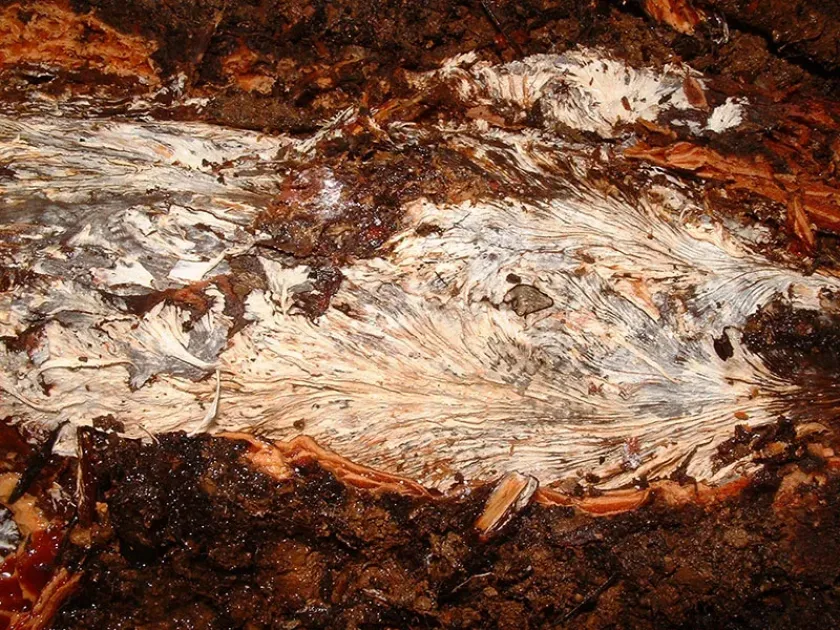
Removing a patch of bark at the base of an infected tree typically reveals white, fan-shaped mycelial mats, often accompanied by a distinct mushroom-like odor.
The presence of dark brown or black, string-like rhizomorphs under the bark or around the root collar is a classic diagnostic marker of Armillaria infection.
In conifers, resin flow at the base of the trunk is a common defensive response, although it rarely prevents the eventual death of the tree.
In later stages, clusters of honey-colored mushrooms appear around the base of the stem or on nearby stumps, signaling severe decay of the root system.
Pathogen
Armillaria sinapina is a pathogenic fungus belonging to the Physalacriaceae family, known primarily as a cause of root and butt rot in various tree species.
This pathogen spreads primarily through the soil using rhizomorphs, which are thick, root-like mycelial cords capable of growing across significant distances to find new hosts.
Unlike some other Armillaria species, Armillaria sinapina is highly effective at exploiting stressed or weakened trees in cool temperate climates.
The fungus produces mushrooms (basidiocarps) during the autumn, which release spores that can colonize decaying wood, facilitating the long-distance spread of the disease.
Its complex life cycle, involving both sexual and asexual stages, makes it a resilient and persistent threat in both managed forests and natural ecosystems.
Conditions for development
The development of Armillaria sinapina is heavily dependent on soil moisture; poorly drained or waterlogged soils are especially conducive to the spread of rhizomorphs.
Trees weakened by drought, insect defoliation, or mechanical injuries to the root system are significantly more susceptible to successful colonization.
Large reservoirs of woody debris, such as old stumps and downed logs, act as primary infection centers from which the fungus attacks neighboring healthy trees.
Temperature fluctuations and high relative humidity in the autumn promote the maturation of fruiting bodies and the subsequent dispersal of fungal spores.
Dense, compacted soils that limit root penetration often exacerbate the disease, as they create an environment where the fungus can easily dominate the root zone.
Why it matters
The primary damage caused by Armillaria sinapina is the destruction of the cambium layer in the roots and root collar, leading to total tree mortality.
By disrupting the translocation of water and minerals, the fungus causes systemic dehydration, which can kill even large, mature trees within a few seasons.
In forestry, the disease typically manifests as expanding gaps in stands, causing significant economic losses and altering the local forest structure.
The infection degrades the wood quality, rendering the base of the trunk structurally unsound and increasing the risk of hazardous windthrow during storms.
Nursery stock is particularly vulnerable, as the pathogen can wipe out entire batches of seedlings, severely hindering reforestation efforts and commercial planting.
Protection
Effective management starts with rigorous site sanitation, including the removal of stumps and large woody residue that serve as the fungus's primary food source.
Silvicultural practices that promote tree vigor, such as thinning to reduce competition and proper spacing, are essential for increasing stand resistance.
In cases of confirmed infection, isolating the site by creating root-trenching barriers can help prevent the spread of rhizomorphs to adjacent healthy trees.
Biological control methods, particularly the use of antagonistic fungi like Trichoderma species, are being explored to suppress Armillaria in the soil.
Strategic selection of resistant tree species based on site conditions is the most reliable long-term strategy for minimizing impact in high-risk areas.
Discussion
No discussions yet — be the first.