
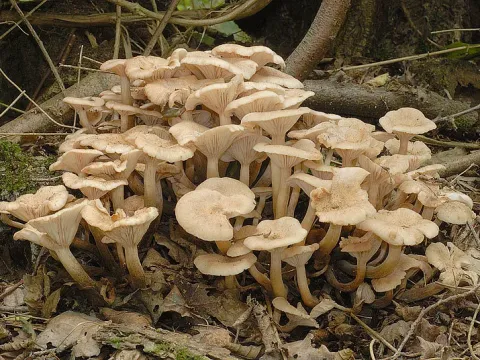
Armillaria tabescens
Armillaria tabescens
The causative agent of the disease is the fungus Armillaria tabescens, belonging to the Physalacriaceae family. A distinct characteristic of this species is the absence of rhizomorphs, which separates it from other honey fungus species.
What the section contains
Armillaria tabescens
This fungus acts as a facultative parasite, capable of surviving on dead wood while also actively infecting healthy woody tissue, leading to root decay.
Infection spreads primarily through root-to-root contact, allowing the fungus to move from infested debris to healthy plant root systems underground.
The pathogen is highly resilient, maintaining its viability in soil for long periods by surviving on rotting organic matter.
Its biological cycle is favored by warm temperatures and moist soil conditions, which are typical in many garden and orchard environments.
Symptoms often manifest as general tree decline, including stunted growth, leaf chlorosis, and premature leaf drop, which can be mistaken for drought stress.
In sensitive species like Apple or Pear, the disease eventually leads to the sudden wilting and death of the entire tree or individual limbs.
Removing the bark at the root collar reveals a white, fan-shaped mycelial mat, often accompanied by a distinctive, sharp fungal odor.
Clusters of honey-colored mushrooms appear around the base of the infected plant during late summer or autumn, which are the most visible reproductive structures.
The root system and the lower stem tissues soften, becoming decayed and sponge-like, losing their structural integrity over time.
The fungus thrives in moist, poorly drained soils, which promote the rapid expansion of the mycelium throughout the root zone.
Environmental stress, such as drought, winter injury, or physical damage, weakens plants and significantly increases their susceptibility to infection.
Decaying stumps or buried woody debris serve as major reservoirs, allowing the pathogen to persist and infect new hosts planted nearby.
Species such as Rhododendron and Avocado are particularly sensitive, and proper soil management is essential to minimize the risk of infection.
The infection rate increases during seasons with high precipitation, which facilitates the spread of fungal spores and mycelial growth.
The disease is highly destructive as it typically results in the death of the infected plant, with no effective curative treatments for advanced stages.
It often spreads in expanding patches, leading to the loss of groups of plants or entire sections of an orchard or garden.
Economic losses are severe due to the necessity of removing entire trees and the long-term contamination of the soil, which prevents immediate replanting.
The degradation of the root system impairs nutrient and water uptake, causing long-term yield reduction before the tree finally succumbs.
Structural damage to the base of the tree increases the danger of toppling, especially during high-wind events.
Effective management begins with rigorous sanitation: removing stumps and all woody roots from the soil before establishing a new planting site.
Promoting overall plant vigor through balanced fertilization and proper irrigation helps increase resistance to initial colonization.
When an infection is confirmed, the affected plant should be removed immediately, ensuring the entire root system is cleared from the site.
Soil solarization or the use of specific fungicides in the affected area may help reduce the inoculum density, although it rarely eliminates the fungus completely.
- Remove all dead stumps and roots;
- Ensure proper soil drainage;
- Monitor for mycelial mats at the base;
- Avoid planting susceptible species in infested soil;
- Sanitize tools after maintenance.