
Armillaria fuscipes
Armillaria fuscipes
The fungus Armillaria fuscipes is a soil-borne pathogen belonging to the Physalacriaceae family. It is recognized as an aggressive species within the honey fungus complex, capable of transitioning between saprotrophic and parasitic growth phases.
What the section contains
Armillaria fuscipes
The pathogen spreads through the soil by producing rhizomorphs — specialized mycelial strands that resemble black shoestrings. These structures facilitate the exploration of the root zone and enable the fungus to bridge the gap between infected and healthy trees.
The life cycle of Armillaria fuscipes is inherently linked to dead wood. Once established in a stump or woody debris, the fungus accumulates sufficient resources to invade the living tissues of stressed or weakened hosts.
Due to its high degree of ecological adaptation, this fungus is a persistent problem in forest ecosystems. It can remain viable in infected root systems for decades, waiting for favorable conditions to expand its colony.
Genomic studies highlight the virulence factors of this species, particularly its robust enzymatic apparatus designed to break down tough plant cell walls, allowing for rapid internal spread once penetration occurs.
Early symptoms are often subtle, starting with leaf chlorosis, stunted shoot growth, and premature foliage drop. Over time, the tree crown displays progressive dieback starting from the top and moving downwards.
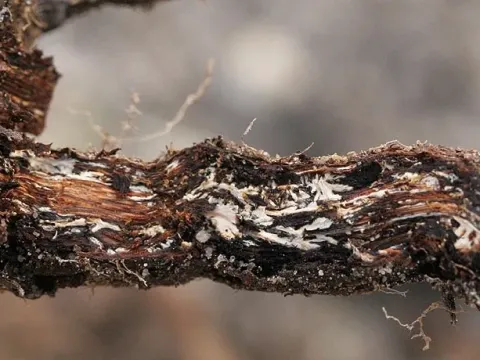
Under the bark at the root collar, a diagnostic feature is the presence of white, fan-shaped mycelial mats. These mats effectively girdle the tree, disrupting the flow of water and essential nutrients.
The presence of dark, tough rhizomorphs in the soil near the root crown is a key indicator of infestation. In late summer or autumn, characteristic honey-colored mushrooms may appear in clusters around the base of the trunk.
The bark tissues often show signs of necrosis, splitting, and decay. In conifers, heavy resin flow is frequently observed at the base of the trunk, indicating the plant's failed attempt to wall off the infection.
- Chlorosis and premature defoliation.
- White fan-shaped mycelium under the bark.
- Black shoe-string rhizomorphs in the soil.
- Clustered honey mushrooms at the base.
- Soft, white rot in the root system.
The disease thrives in environments with high soil moisture levels. Periods of heavy rain followed by moderate temperatures create the optimal conditions for the explosive growth of fungal rhizomorphs.
Host susceptibility is significantly increased by environmental stressors. Drought, poor site drainage, and mechanical injuries to the root system make trees vulnerable to the opportunistic invasion of the pathogen.
High planting density contributes to the rapid spread of the disease. The fungus moves efficiently between trees through direct root contact, creating expansive infection centers in plantation sites.
Poor soil management and the accumulation of decaying woody debris serve as major infection reservoirs. The presence of these organic substrates ensures the fungus remains active in the soil for extended periods.
Inappropriate forest management practices, such as failing to remove infected stumps, provide a continuous bridge for the fungus to persist and re-infect subsequent rotations of trees.
The primary damage caused by Armillaria fuscipes is the destruction of the root system and the lower bole, leading to tree death. This loss of structural integrity often results in windthrow, posing safety risks.
In commercial forestry, the disease causes significant economic losses due to the degradation of timber quality and the loss of entire stands. The infection is notoriously difficult to eradicate once a site is infested.
The impact extends to horticultural and urban settings, where valuable ornamental and fruit trees can be killed quickly. Replacement planting is often unsuccessful because the pathogen remains in the soil.
By attacking the root crown, the pathogen compromises the plant’s entire physiological system. The eventual decline and death of the tree lead to a loss of ecological functions and aesthetic value.
Due to its ability to attack a wide range of tree species, the disease acts as a significant threat to biodiversity in both natural and planted landscapes across its range.
Effective management begins with strict sanitation practices. Infected trees must be removed along with as much of the root system as possible to eliminate the main reservoir of the pathogen.
Biological control agents, such as Trichoderma species, have shown promise as soil inoculants to suppress the growth of Armillaria and protect the root zone of healthy or newly planted trees.
Proactive care is essential; maintaining tree health through proper fertilization, watering, and protection from mechanical damage strengthens natural host resistance against fungal colonization.
When infection is detected, creating isolation trenches can prevent the spread of rhizomorphs through the soil, effectively isolating the infection center from the surrounding healthy stand.
Selection of resistant species is the most sustainable long-term strategy. Before planting, assessing the site for previous infection history is crucial to choosing appropriate tree varieties that can withstand the pathogen.