
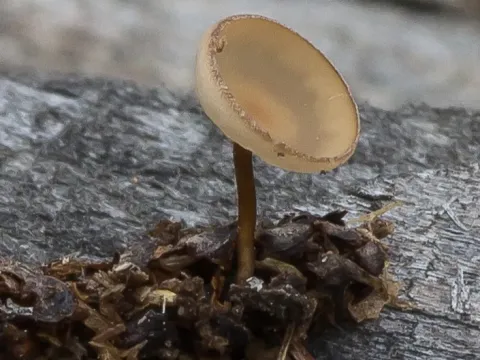
Alder catkin cup
Ciboria amentacea
The primary symptom of this infection is the premature dropping or deformation of alder catkins. Infected reproductive organs change their color to dark brown or black, becoming easily distinguishable from healthy tissues.
What the section contains
Alder catkin cup
The pathogen develops fruit bodies known as apothecia within the infected catkins. These appear as small, cup-shaped structures on thin stalks that emerge from the catkin tissue during the spring season.
The tissue of the affected catkin becomes brittle. Under favorable conditions, a dense mass of fungal mycelium forms inside, eventually creating a sclerotium that allows the fungus to survive winter conditions.
Visually, an infected catkin appears shriveled, and premature opening of the scales is often observed. During the spring, one can spot the characteristic brown discs of the fruit bodies growing on the fallen debris.
The disease often goes unnoticed until the massive spore release phase. However, for nurseries specializing in alder seed production, this disease is a critical factor that severely impacts seed viability.
The pathogen responsible for this disease is the fungus Ciboria amentacea, a member of the Ascomycota division. It is a highly specialized parasite that completes its biological cycle exclusively on alder (Alnus) species.
Development of the fungus is favored by high humidity and moderate temperatures during spring. Spores are released from the apothecia and spread through wind and rain droplets to colonize developing alder catkins.
The main economic impact is the destruction of seed crops. This significantly reduces the quality and quantity of seeds available for forestry, hindering natural regeneration and nursery operations in affected regions.
Effective control measures include the removal and destruction of fallen catkins, which serve as the primary source of inoculum. In managed forest stands or nurseries, the application of fungicides during the flowering period can prevent infection.