
Alder crust
Vuilleminia alni
Description
Symptoms
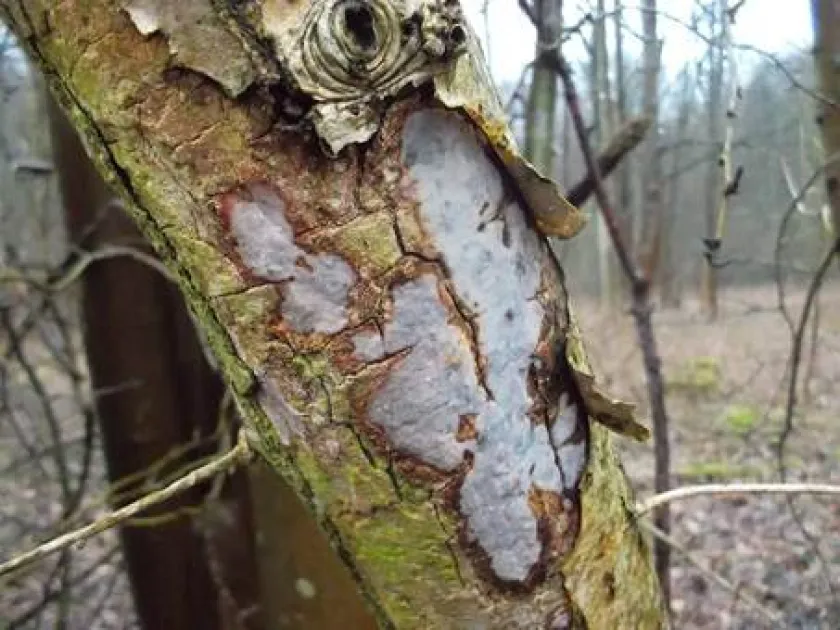
The most diagnostic feature is the premature detachment of the bark. Affected bark becomes loose, begins to crack, and often peels away in large, dry strips or sheets.
Fruiting bodies of Vuilleminia alni appear as thin, spread-out crusts on the surface of dead or dying bark. They often have a waxy or leathery texture when hydrated.
Coloration of the fungal crust ranges from pale yellowish to dark brown as it ages or dries out. These growths are frequently found on branches that have lost their foliage.
Under the loose bark, a white or whitish mycelial mat is often visible. This mat indicates extensive colonization by the fungus, which restricts the flow of water and nutrients.
- Wilting and eventual death of individual branches.
- Bark loosening and peeling in strips.
- Presence of waxy crust-like fruiting bodies.
- Exposure of bare wood after bark falls away.
Pathogen
The causal agent is a wood-decay fungus known as Vuilleminia alni, a member of the Basidiomycetes phylum. This pathogen predominantly affects trees within the Betulaceae family.
The fungus functions as both a saprotroph and a weak parasite. It develops primarily beneath the bark, slowly dismantling the conductive tissues and essential bark layers of the host plant.
Its biological cycle is characterized by the detachment of the bark from the woody cylinder. The mycelium penetrates the cambial zone, weakening the structural integrity of the affected branch or stem.
Dissemination occurs via spores, which are easily transported by air currents, splashing rain, or even insects. This allows the fungus to spread efficiently through woody stands.
As the fungus matures, it forms crust-like fruiting bodies. These structures ensure the production of new spores, maintaining the infection cycle in favorable conditions.
Conditions for development
High humidity and moisture are the primary environmental drivers for the development of Vuilleminia alni. Frequent rainfall creates the perfect environment for spore germination.
Dense canopies and poor air circulation contribute to the spread of the disease. When moisture is trapped between branches, the fungus colonizes the host more rapidly.
Mechanical injuries are critical entry points. Damage from wind, snow, or insects creates wounds that the fungus readily exploits to initiate infection.
Trees stressed by drought, poor soil quality, or competition are significantly more susceptible to infection compared to healthy, vigorous specimens.
Moderate temperatures during the growing season facilitate the active metabolism of the mycelium, allowing the disease to progress steadily through the tree's architecture.
Why it matters
The primary impact of Vuilleminia alni is the gradual dieback of branches. This weakens the tree, reduces its leaf cover, and disrupts vital physiological functions.
By killing sections of the bark, the fungus creates opportunities for wood-boring insects and other, more aggressive pathogens to enter the trunk.
The loss of bark reduces the tree's protective barrier, potentially leading to deep wood decay, which compromises the structural stability of the tree over time.
In ornamental settings, the visible peeling of bark and branch death significantly diminish the aesthetic value of the trees and surrounding landscape.
In silvicultural contexts, this pathogen causes timber degradation, leading to economic losses and the necessity of intensive forest sanitation efforts.
Protection
Sanitation pruning is the most effective management strategy. All infected branches must be removed, cutting well into healthy wood to ensure no mycelium remains.
Disposal of infected material is crucial; branches should be burned or buried to prevent spores from blowing back into healthy sections of the stand.
Maintenance of tree health through adequate irrigation and nutrient management helps plants maintain their natural resistance against fungal invasion.
Improving air circulation by thinning the canopy can decrease local humidity, making the environment less favorable for the survival and growth of the fungus.
Early spring applications of copper-based fungicides can act as a protective barrier, reducing the success rate of spore colonization on susceptible bark surfaces.
Discussion
No discussions yet — be the first.