
Alder leaf curl
Taphrina alni
Description
Symptoms
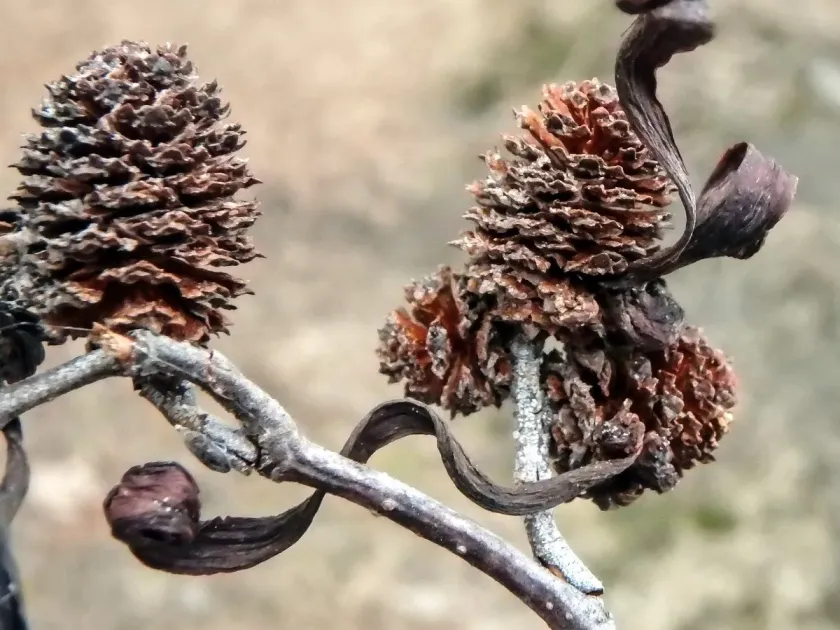
The most distinctive symptom of this disease is the severe morphological deformation of male catkins. Instead of their typical slender shape, they become enlarged, fleshy, and irregularly twisted or lobed.
These deformed catkins often develop a striking color change, turning from standard brownish-yellow to bright green, yellow-green, or reddish, making them very noticeable against normal foliage.
A fine, waxy, or velvety coating often covers the surface of the affected catkins. This is the sporulation layer of the fungus, confirming the presence of the pathogen on the infected host.
Unlike healthy catkins that shed their pollen and fall off naturally, the diseased catkins tend to persist on the branches for an extended period, creating a unique and abnormal appearance.
In some cases, the infection may lead to localized shoot swelling or the formation of stunted, distorted growth that disrupts the normal branching pattern of the affected alder branch.
Pathogen
The causal agent of this disease is the sac fungus Taphrina alni, a member of the Taphrinaceae family. It is a highly specialized biotrophic pathogen that exclusively affects alder trees.
The fungus maintains a perennial mycelium within the shoots of the host tree. This allows the pathogen to survive and spread throughout the branches over multiple growing seasons without killing the host immediately.
During the early spring, the fungus becomes active and colonizes the developing catkins of the alder. This process is perfectly synchronized with the host's phenology to maximize reproductive success.
The fungus overwinters as chlamydospores or mycelial fragments tucked away in bark crevices or bud scales. As soon as temperatures rise, these infective units initiate the colonization of the new reproductive tissues.
The lifecycle concludes with the production of ascospores on the surface of the deformed organs. These spores are then dispersed by wind and rain, completing the cycle and ensuring the survival of the pathogen.
Conditions for development
The development of Taphrina alni is heavily dependent on specific weather conditions during the early spring period. Cool and wet weather is the primary catalyst for infection.
Prolonged rainfall during the bud-break and flowering stage provides the perfect moisture environment for spore germination and successful colonization of the tender catkin tissues.
High relative humidity and frequent fog contribute to the persistence of spores on the tree surface, significantly increasing the probability of new infections within the stand.
Wind plays a critical role in the dissemination of spores across forest areas. Once airborne, the spores can easily travel to neighboring trees, leading to widespread outbreaks.
Trees that are under physiological stress, perhaps due to soil conditions or competition, often exhibit higher susceptibility to the disease compared to more vigorous individuals.
Why it matters
The primary damage caused by alder leaf curl is the loss of reproductive output. Infected catkins fail to produce pollen, which inhibits the tree's ability to propagate sexually.
Over time, high infection rates can lead to a decline in natural regeneration within alder forests, potentially altering the population dynamics of the local ecosystem.
The metabolic drain caused by the fungus as it extracts nutrients from the tree reduces the overall energy reserves available for growth, leading to decreased annual wood increment.
In ornamental and urban landscapes, the disease significantly detracts from the aesthetic value of the trees, necessitating costly removal of infected tissues to restore the visual appeal.
Chronic infection weakens the tree's constitution over many years, making it more susceptible to secondary stressors, such as bark beetles or environmental changes, potentially shortening the tree's lifespan.
Protection
Managing Alder leaf curl primarily involves sanitation. Removing and disposing of the deformed catkins before they have a chance to release spores is the most effective way to curb the disease.
In high-value ornamental settings, prophylactic fungicide sprays (especially copper-based formulations) can be applied in late winter or very early spring to protect buds from infection.
Promoting good airflow around the tree canopy through proper spacing and occasional pruning helps to reduce the microclimate humidity that the fungus requires to thrive.
Selecting and planting genetically resistant or less susceptible alder clones is considered the most sustainable and long-term strategy for managing the disease in plantation forestry.
- Regular monitoring of tree health during the spring season.
- Burning or deep burial of removed infected catkins.
- Enhancing tree vigor through proper fertilization and water management.
Discussion
No discussions yet — be the first.