
Bryoria
Bryoria
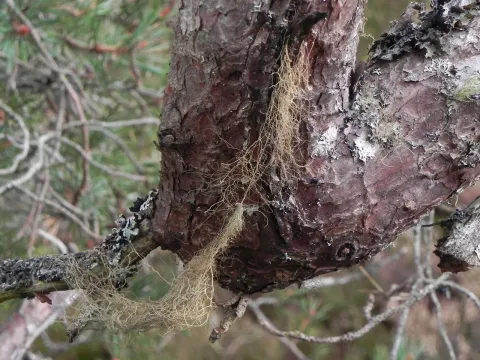
Bryoria is a genus of hair lichens characterized by dark, pendulous, and highly branched thalli. These organisms often drape over the branches of coniferous trees like long, coarse beards.
What the section contains
Bryoria
Many observers mistake this growth for a fungal infection or a necrotic disease. However, it is an epiphyte, meaning it lives on the tree surface without penetrating the inner tissues.
The visual appearance can be dense, sometimes covering large parts of the tree crown. Unlike pathogenic fungi, the structure of Bryoria is dry and hair-like, not slimy or crusty like typical plant diseases.
Signs of Bryoria presence include visible gray, brown, or black filaments hanging from limbs. There is no associated resin leakage or tissue decay visible beneath the lichen attachments.
These lichens are essential indicators of air quality. Their presence is a sign of a healthy, non-polluted environment where air remains clean and free of heavy toxic particles.
Bryoria is strictly not a plant pathogen. It does not cause disease, nor does it consume the plant's resources. It is a symbiotic relationship between a fungus and algae, relying solely on the tree as a mechanical substrate.
The lichen does not infect the tree’s phloem or xylem. There is no host-parasite relationship, meaning the tree remains unharmed regardless of the density of the lichen coverage on its branches.
Biological studies classify Bryoria as a common epiphytic lichen. It does not produce toxins or enzymes capable of damaging the bark or affecting the physiological processes of the tree host.
Confusing this lichen with a plant disease can lead to unnecessary and potentially harmful use of chemicals in a forest or orchard setting.
Recognition of Bryoria as a harmless component of the forest canopy is essential for proper forest management and maintaining ecological balance.
The development of Bryoria populations is strictly tied to cool, humid climates with frequent fog. It thrives in high-moisture environments where the thallus can absorb water from the air.
Growth is slow and requires long periods of stable, clean atmospheric conditions. Industrial pollution, particularly sulfur dioxide, is highly detrimental to the survival of Bryoria species.
The lichen favors old-growth coniferous trees where the bark texture provides stable attachment points. As the trees age, they become more suitable substrates for the slow-spreading thalli.
Light intensity is also a factor, as Bryoria prefers environments where moisture levels are maintained throughout the day, often found in dense forests or coastal areas.
Colonization is a passive process where spores travel via wind, settling on suitable bark surfaces. Once established, they expand only if the local microclimate remains consistently favorable.
Bryoria causes no direct damage to its host tree. It does not block transpiration, prevent photosynthesis, or cause mechanical stress, even when present in large quantities.
There is no impact on timber quality or tree growth rates. As an epiphyte, its lifecycle is independent of the tree's health, making it an ecologically neutral species.
It does not affect crop plants, as its distribution is limited to coniferous forests and wild habitats. No economic damage to agriculture has ever been recorded from Bryoria.
The lichen serves as a food source for some forest animals, including deer and caribou, which can forage on fallen Bryoria during winter months, adding a positive ecological value.
Therefore, there is no justification for managing or removing Bryoria. It is a harmless visitor that reflects the natural stability of the forest ecosystem.
No control measures are required because Bryoria is not a pathogen. Treating this lichen with fungicides would be counterproductive, destroying beneficial microflora and polluting the forest environment.
Preventative actions are unnecessary. Efforts should focus on genuine forest pathology issues rather than the presence of lichen species that do not threaten tree viability.
If removal is deemed necessary for aesthetic reasons, such as in public landscaping, it should be done manually. Care must be taken not to damage the bark of the trees during the process.
Forest management should prioritize preserving these lichens as bioindicators. Their disappearance is often a warning sign of declining air quality in a region.
In conclusion, professional agronomy and forestry practices treat Bryoria as a benign epiphyte that contributes to biodiversity without requiring any phytosanitary intervention.