
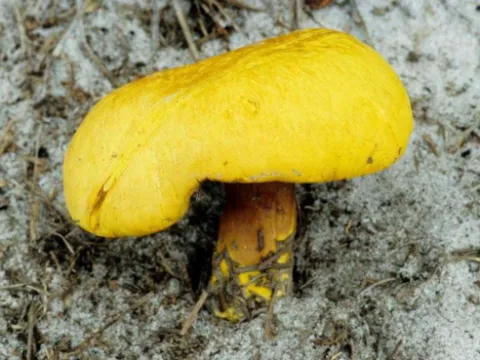
Buchwaldoboletus hemichrysus
Buchwaldoboletus hemichrysus
The pathogen is the fungus Buchwaldoboletus hemichrysus, belonging to the family Boletaceae. Unlike typical mycorrhizal boletes, this species exhibits clear saprotrophic tendencies and can act as a parasite on wood.
What the section contains
Buchwaldoboletus hemichrysus
This fungus is capable of colonizing dead or weakened coniferous wood, initiating the development of specific wood rot. Its biological activity is primarily directed at decomposing complex wood structures.
The mycelium actively penetrates the timber, breaking down lignin and cellulose. This process fundamentally alters the structure of the wood fibers, rendering the timber unsuitable for plant stability and growth.
The species is considered relatively rare and site-specific. Its life cycle is closely linked to the degradation of coniferous forests, where it functions as a decomposer, although in managed plantations it may represent a risk.
Unlike primary pathogens, Buchwaldoboletus hemichrysus is often observed as a secondary agent, colonizing areas of bark or trunks already affected by environmental stress or injury.
The main visible sign is the emergence of bright yellow or golden-yellow fruit bodies directly on the surface of the affected wood or bark.
Upon infestation, the wood tissue changes color, becoming softer and acquiring a brownish tint, which indicates active internal decomposition of the fibers.
In areas where the mycelium is dense, yellow fungal films or web-like structures may be visible within bark cracks or on exposed wood surfaces.
The fruit bodies feature a tubular hymenophore that may exhibit slight color changes when pressed. The intense coloration of the cap is a key marker for identifying this species in plantations.
Over time, the affected wood begins to crumble, losing its mechanical strength. In advanced stages, bark peeling is commonly observed in areas of active colony growth.
The development of the fungus is most intensive under conditions of high humidity and moderate temperatures, which are typical for forest ecosystems during the summer season.
A critical factor for infestation is the presence of weakened or mechanically damaged coniferous trees, which provide a suitable substrate for fungal spores to germinate.
Accumulations of dead wood, such as stumps or fallen trunks, create an ideal nutrient base for mycelium growth and the continued spread of the pathogen.
The fungus prefers shaded areas with poor air circulation, where moisture is retained on the wood surface, facilitating the development of the fungal colonies.
The optimal temperature range for the active formation of fruit bodies of Buchwaldoboletus hemichrysus is between +15 and +25 degrees Celsius.
The primary damage involves accelerated wood decay, which leads to the premature death of weakened trees and a significant reduction in their economic and structural value.
In forestry, this fungus can promote the spread of decay processes, thereby weakening the overall resilience of the forest stand to other pests and secondary diseases.
Due to the loss of structural integrity in the trunk, infested trees become highly susceptible to windthrow and snowbreak, which often leads to major losses in plantations.
The presence of fungal colonies negatively affects the local ecosystem by making the environment less suitable for the regeneration of healthy tree populations.
Economic losses are associated with the necessity of sanitary logging and the depreciation of raw timber obtained from the affected forest areas.
The primary method of prevention is the consistent sanitary cleaning of forest areas, involving the removal of deadwood, dry trees, and old rotting stumps.
Maintaining tree vigor through proper silvicultural practices and balanced fertilization significantly improves the plant's resistance to fungal infections.
If local centers of infestation are detected, it is recommended to remove and destroy the affected wood to prevent the further dispersal of spores.
The use of fungicides or specialized wood preservatives to treat wounds or cuts on tree trunks helps prevent the infection from penetrating into healthy tissues.
- Regular monitoring of tree health during the summer months.
- Ensuring adequate aeration and sunlight to prevent excess moisture.
- Isolation and elimination of all infection sources within the site.
- Planting rot-resistant tree species in high-risk zones.