
Eyespot of sugarcane
Bipolaris sacchari
The causal agent of this disease is the fungus Bipolaris sacchari (syn. Helminthosporium sacchari), a member of the Ascomycota phylum. It is a filamentous fungus that spreads via conidia produced on specialized conidiophores.
What the section contains
Eyespot of sugarcane
This pathogen survives during the off-season as mycelium or spores within infected plant debris or on alternative grass hosts. It acts as a primary parasite capable of rapid colonization during the sugarcane growing period.
The fungus produces a specific host-selective toxin known as helminthosporoside. This toxic compound is responsible for the characteristic leaf lesions by causing cell permeability changes and necrosis in host tissues.
Spread is primarily facilitated by wind and splashing raindrops, which move spores from older infected leaves to younger, susceptible tissue, enabling rapid secondary cycles of infection.
Understanding the life cycle of Bipolaris sacchari is essential for implementing effective management practices, as the fungus exhibits high phenotypic plasticity under varying environmental conditions.
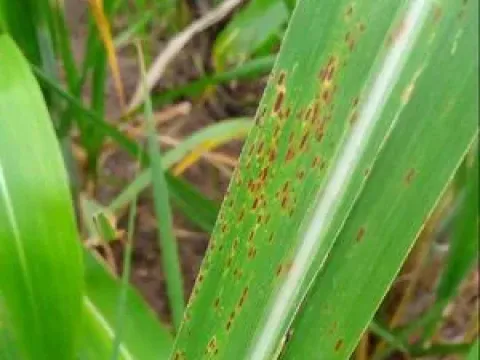
Initial symptoms present as small, watery spots on the leaf blades. As the lesion matures, it elongates parallel to the leaf veins, taking on an oval, eye-like shape from which the disease derives its common name.
The centers of the lesions typically turn straw-colored or tan, surrounded by a distinct dark brown or reddish-brown halo. In conditions of high humidity, an olive-black mold, representing the fungus's sporulation, appears in the center of the spots.
In cases of severe infestation, individual spots coalesce to form large, necrotic patches that cover vast areas of the leaf surface. This leads to the premature yellowing and death of the entire leaf.
In some susceptible varieties, the disease may also manifest as long, necrotic streaks on the stalk, which can impede the plant's vascular transport and overall development.
- Appearance of small water-soaked lesions
- Elongated oval spots with reddish-brown margins
- Olive-black sporulation under moist conditions
- Premature chlorosis and leaf necrosis
Eyespot development is heavily dependent on environmental conditions, specifically high relative humidity and rainfall. Periods of prolonged leaf wetness are critical for spore germination and infection.
The optimal temperature range for the pathogen's growth and infection is between 20°C and 28°C. These temperatures coincide with the active growth phases of the sugarcane crop.
Dense, overcrowded planting patterns promote poor air circulation, which traps humidity within the canopy. This microclimate is highly conducive to the spread of fungal spores and disease progression.
Plants subjected to excessive nitrogen fertilization may develop softer, more succulent leaf tissues, making them significantly more vulnerable to penetration by the fungal mycelium.
Frequent dew and light rain showers during the growing season provide the necessary moisture for the fungus to complete its life cycle repeatedly throughout the year.
The primary economic impact is the reduction of the leaf photosynthetic area, which directly translates to suppressed plant growth and lower total biomass accumulation per hectare.
The disease severely impacts sugar quality by reducing the sucrose content in the stalks. This reduction in sugar yield makes processing less efficient and less profitable for sugar mills.
Premature leaf drop undermines the plant's structural integrity, potentially leading to lodging, which significantly complicates mechanical harvesting operations and increases field losses.
Chronic infections weaken the sugarcane root system, making the entire plantation more susceptible to other biotic and abiotic stresses, leading to a long-term decline in yield over successive ratoon crops.
In cases of epidemic outbreaks, the combination of lower sugar concentration and reduced juice purity requires costly purification processes, significantly lowering the market value of the harvested cane.
The most effective long-term management strategy is the planting of resistant or tolerant sugarcane cultivars. Breeding programs focus on identifying genetic sources of resistance to Bipolaris sacchari.
Good agricultural practices, such as maintaining appropriate plant spacing and row orientation, help ensure sufficient air movement within the field, thereby reducing leaf moisture levels.
Post-harvest field sanitation, including the destruction or incorporation of crop residue, is crucial for reducing the primary inoculum source that survives in the field.
Chemical control using systemic fungicides can be employed during the early stages of disease development to protect young plants, provided that economic thresholds are met.
Balanced nutrient management, avoiding excessive nitrogen and ensuring adequate potassium levels, helps maintain plant health and natural defense mechanisms against fungal pathogens.