
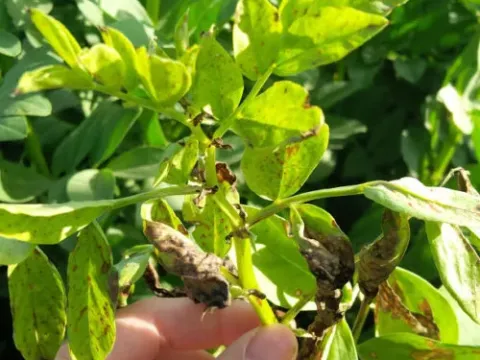
Faba bean necrotic yellows virus
Faba bean
The causative agent of the disease is the Faba bean necrotic yellows virus (FBNYV), a member of the Nanoviridae family. It is a single-stranded DNA virus known for its multicomponent genome structure.
What the section contains
Faba bean necrotic yellows virus
The virus is transmitted by various aphid species, with the pea aphid being the primary vector in many regions. Transmission occurs in a persistent, circulative manner, meaning the aphid remains infectious for a long period after feeding on an infected plant.
The pathogen primarily colonizes the phloem tissue of the host plant. By disrupting the transport of nutrients and photoassimilates, the virus induces a severe systemic infection that leads to stunting and physiological decline.
FBNYV has a broad host range within the legume family. Crops such as faba beans, lentils, and chickpeas are highly susceptible to this pathogen under favorable environmental conditions.
Scientific research highlights the virus's ability to adapt to different hosts, making it a significant concern for international phytosanitary safety and sustainable pulse production.
The most prominent symptom is severe stunting, where plants fail to reach their normal height. Development is significantly retarded compared to healthy neighboring plants.
Leaves often exhibit intense yellowing (chlorosis), which typically begins at the growing point and moves downward. This yellowing is distinct and often accompanied by leaf curling or deformation.
Internode shortening is a hallmark of the infection, causing a rosetted appearance. The plant loses its normal structural architecture, appearing bushy and severely dwarfed.
Infected plants rarely produce flowers or pods. If pods do form, they are typically malformed, small, and often contain aborted or shriveled seeds, leading to a total loss of reproductive potential.
In field settings, the disease manifests in patches. These patches represent initial infection points where winged aphids landed and transmitted the virus, subsequently spreading to adjacent plants.
The prevalence of FBNYV is directly linked to aphid population dynamics. Warm and dry spring conditions are ideal for aphid migration and rapid colonization of young legume crops.
The presence of alternative hosts, such as perennial legumes and various weeds, serves as a reservoir for the virus. These reservoirs allow the pathogen to survive during periods when primary host crops are not available.
Temperature significantly influences the incubation period and symptom development. Higher temperatures generally accelerate viral replication within the plant, leading to more severe and visible disease symptoms.
Wind-driven migration of aphids plays a crucial role in spreading the virus over long distances. Once an area is infested, the virus can quickly move across entire fields, creating epidemic conditions.
Plants under environmental stress, such as drought or nutrient deficiency, often show increased susceptibility to viral infection and aphid colonization.
FBNYV is extremely damaging to chickpea and other pulse production. In severe infection scenarios, farmers may experience complete crop failure, rendering the fields unproductive.
Infections occurring at the seedling stage are particularly devastating. Such plants typically never reach a reproductive state, leading to massive yield losses across the affected acreage.
Seed quality is severely impacted. Seeds harvested from infected fields are often small, shriveled, and show poor germination rates, making them unsuitable for subsequent planting.
The virus suppresses the plant's natural immune system, making it more susceptible to opportunistic fungal and bacterial pathogens, such as root rot, which further exacerbates the damage.
The economic impact includes not only the loss of potential harvest but also the increased costs associated with vector control and the need for expensive replanting efforts.
The primary control strategy involves managing aphid populations. Systematic application of insecticides is necessary to suppress vector activity, especially during the early stages of crop development.
Maintaining spatial isolation from other legume crops or perennial pastures is essential to reduce the risk of aphid immigration. This practice is fundamental in preventing initial field infection.
Regular field scouting is critical for early detection. Identifying and removing infected plants in the early stages can help limit the spread of the virus within a field.
Breeding and selecting resistant or tolerant cultivars remain the most sustainable and effective methods for long-term disease management against FBNYV.
- Systemic insecticide applications
- Monitoring aphid populations
- Spatial separation of legume fields
- Weed management to eliminate viral reservoirs
- Use of virus-free certified seeds