
Fabraea leaf spot
Fabraea congener
Description
Symptoms
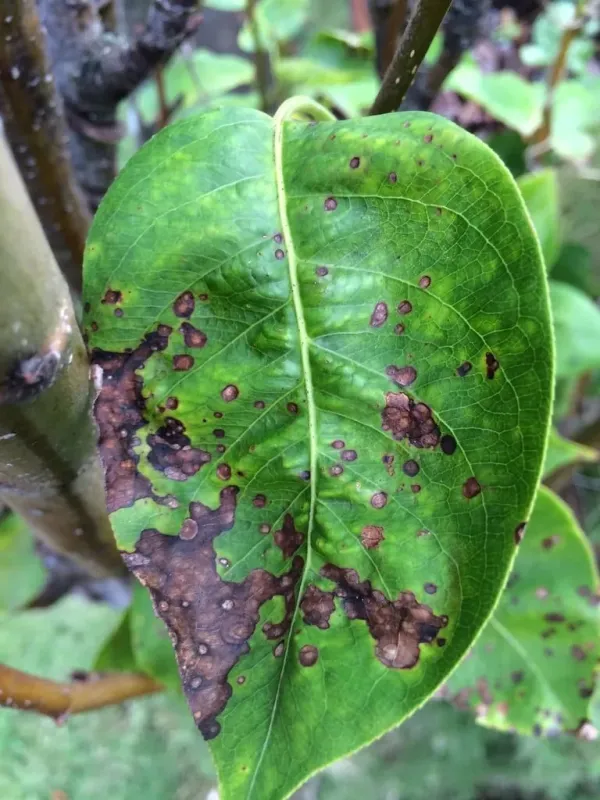
The initial manifestation appears as small, circular, reddish-brown spots scattered across the leaves. As the infection progresses, these spots expand significantly and often coalesce, leading to large necrotic areas.
Tiny black acervuli, or fruiting bodies, typically develop in the center of the lesions. These structures are crucial for identification, as they serve as the site for spore production and release throughout the summer months.
Heavy infection causes severe chlorosis followed by rapid leaf drop. Trees may be completely defoliated mid-season, which is a major red flag for this disease compared to other, less aggressive leaf spot pathogens.
Stems and petioles are also susceptible to lesion formation. These can lead to dieback of small shoots, as the fungal growth may girdle the tissue, cutting off essential nutrients and water flow to the distal parts of the plant.
The overall appearance of the tree becomes sparse and weak, with withered leaves accumulating under the canopy. Early defoliation often gives the tree a late-autumn look in the middle of summer.
Pathogen
The disease is caused by the fungus Fabraea congener, an ascomycete pathogen known for affecting various trees, particularly in the Rosaceae family. The fungus completes its life cycle by forming fruiting bodies on decaying plant material.
Infection begins when conidia are spread by wind or water splashes, landing on susceptible leaf surfaces. Once it penetrates the cuticle, the fungus develops a mycelial network that systematically exploits the host's cellular tissues.
Overwintering occurs primarily within the fallen leaves on the ground. When spring arrives, these infected leaves release spores that initiate the primary infection cycle of the new growing season.
While Fabraea congener has a preference for specific host genera like hawthorn and mountain ash, it can spread to others if environmental conditions remain favorable. Its biology is finely tuned to coincide with the leaf emergence phase of the host.
The fungus is persistent and highly capable of evolving to overcome basic environmental stresses. Its ability to remain dormant within leaf debris makes it a difficult pathogen to eradicate once it establishes itself in an orchard or nursery.
Conditions for development
The development of Fabraea congener is strongly linked to high moisture levels. Periods of prolonged rainfall, heavy dew, and high humidity provide the essential free water on leaf surfaces needed for successful spore germination.
Temperatures between 15°C and 22°C create the optimal metabolic rate for the fungus to colonize the host tissues. Fluctuations within this range during the spring and early summer often trigger massive outbreaks.
Poor airflow in dense, unpruned canopies traps moisture and elevates local humidity. This microclimate significantly reduces the time required for spores to penetrate the leaf tissue, leading to faster disease progression.
Plants under physiological stress, such as drought or nutrient deficiencies, have weakened defense mechanisms. These trees are significantly more susceptible to infection compared to those grown in optimal conditions.
During dry summers, the disease's rate of spread may slow down, but the pathogen remains viable on the bark or soil. A sudden shift to humid conditions will immediately restart the disease cycle, making vigilance necessary all season long.
Why it matters
The most severe impact is the premature loss of foliage, which deprives the tree of its main source of photosynthesis. Without enough energy reserves, the tree cannot properly store nutrients for the upcoming winter season.
Consequently, winter hardiness is dramatically reduced. Trees often suffer from frost damage or die completely during the following winter because they were too weak to survive the cold period.
Fruit quality and yield suffer significantly in orchard settings. The plant allocates its remaining energy to surviving rather than producing fruit, leading to stunted growth and poor fruit development.
Repeated yearly infections can lead to the slow decline and eventual death of older trees. The cumulative effect of weakened branches and lack of stored energy makes the tree susceptible to secondary pests and pathogens.
In ornamental landscaping, the visual impact is detrimental. The beauty of hawthorns and other species is destroyed by the unsightly, necrotic foliage, necessitating costly removals and replacements.
Protection
Sanitation is the most important management step. Carefully raking up and destroying all fallen leaves at the end of the season prevents the primary inoculum from surviving near the tree roots.
Pruning is essential to improve airflow throughout the canopy. Opening up the tree allows leaves to dry out faster after rainfall, which significantly inhibits the ability of fungal spores to take hold and germinate.
In areas with a history of Fabraea leaf spot, preventative fungicide applications in the early spring are recommended. This helps to protect young, developing leaves before the first wave of spores arrives.
Monitoring the tree throughout the growing season allows for early intervention. If symptoms appear, switching to systemic fungicides can help stop the internal spread of the mycelium.
- Practice deep burial or composting of leaf debris to kill spores.
- Select resistant cultivars whenever available.
- Ensure proper spacing during planting to maintain healthy air movement.
- Regularly fertilize to keep the host tree healthy and less prone to stress.
Discussion
No discussions yet — be the first.