
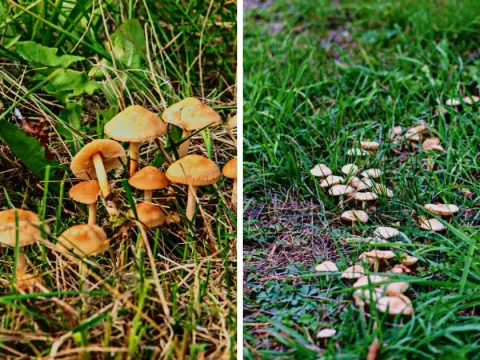
Fairy ring mushroom
Marasmius oreades
The most distinctive symptom of Marasmius oreades infection is the appearance of rings or arcs of dark green, fast-growing grass known as fairy rings.
What the section contains
Fairy ring mushroom
Inside these rings, the grass may often appear stunted or yellowed due to the dense fungal mycelium blocking water and nutrient uptake.
During periods of high humidity and rainfall, small, tan-colored mushrooms appear along the perimeter of these rings, indicating active growth.
The soil within the infected ring often becomes hydrophobic, forming a hardened, water-repellent layer that prevents irrigation from reaching the roots.
As the mycelium expands outward in search of nutrients, the rings gradually increase in diameter, leaving a dead or sparse zone behind the active border.
The causative agent is Marasmius oreades, a saprotrophic fungus that lives in the soil and feeds on decomposing organic matter.
Unlike parasitic fungi that infect plant tissues directly, this species disrupts the turf ecosystem indirectly through its extensive subterranean mycelial network.
The fungus produces nitrogen-rich byproducts during its metabolic processes, which act as a localized fertilizer, causing the characteristic dark green grass.
Its mycelium binds soil particles together, creating a tight, mesh-like structure that effectively chokes the root zone of the grass.
The organism reproduces through spores disseminated by wind, rain, or human activity, such as mowing or transferring contaminated soil.
Fairy rings thrive in soils that are low in nitrogen and organic matter, frequently appearing on sandy, poorly maintained turf areas.
The development of the fungus is heavily influenced by soil moisture levels, with periods of rain followed by warmth triggering rapid expansion.
Lawns with a heavy buildup of thatch provide a consistent food source for the fungus, facilitating its survival and spread across the field.
Poor aeration and compacted soil create favorable conditions for the mycelium to establish a deep, persistent base that is difficult to eradicate.
Environmental fluctuations, particularly cycles of drought and saturation, encourage the fungus to grow as it seeks stable moisture levels.
The primary concern is the significant loss of turf aesthetic and visual uniformity, which detracts from the professional look of landscapes and golf courses.
By creating a hydrophobic barrier in the soil, the fungus induces localized drought stress, leading to the death of grass plants within the ring.
In pasture management, fairy rings can alter the composition of forage crops and temporarily decrease the biomass production of the area.
The accumulation of toxic fungal metabolites can alter the soil chemistry, making it difficult for the original grass species to re-establish after the fungus dies.
Uncontrolled growth can lead to bare patches of soil, increasing the risk of erosion and allowing opportunistic weeds to invade the weakened turf.
Effective management begins with cultural practices such as regular aeration and scarification to break up the fungal mat and improve soil drainage.
Providing adequate irrigation combined with wetting agents is essential to overcome the hydrophobic nature of the soil and restore moisture to the roots.
Maintaining a balanced fertilization program helps mask the visual symptoms and strengthens the turf's overall health against secondary stress.
In severe cases, targeted fungicide applications are used, though they are most effective when applied through soil injection to reach the mycelium directly.
Removing the affected sod and replacing the contaminated soil with a fresh, sterile substrate is the most certain way to eliminate an established colony.