
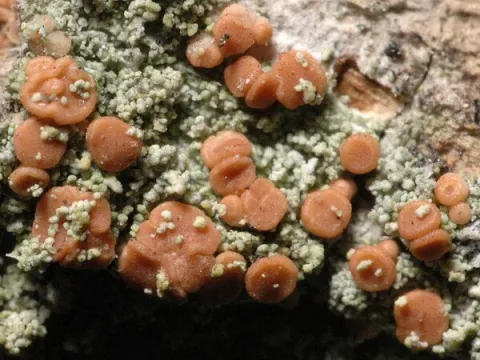
Bacidia rubella
Bacidia rubella
Bacidia rubella is a species of lichen belonging to the family Ramalinaceae. In botanical terms, it is not a pathogenic disease that infects the plant's vascular system, but an epiphytic organism living on the surface of the bark.
What the section contains
Bacidia rubella
The organism consists of a fungal partner and photosynthetic algae or cyanobacteria. It does not penetrate the tree's inner tissues or draw nutrients from its sap, relying entirely on the bark as a structural anchor.
Biology of this lichen involves the development of a thin crustose thallus. It spreads via spores that germinate on surfaces with appropriate moisture levels, primarily in temperate climate zones.
In agronomy, Bacidia rubella serves as an environmental indicator. Its presence on orchard trees often highlights slow bark growth or the overall declining vigor of the host plant.
This species is common on deciduous trees and prefers high-humidity environments. While harmless to the tree's physiology, its unchecked growth indicates that the tree's surface is conducive to epiphytic colonizers.
The primary symptom of Bacidia rubella is the presence of small, reddish-brown apothecia (fruiting bodies) scattered on the bark surface. The reddish tint is the most distinctive feature for field identification.
The thallus appears as a faint, crust-like growth, closely adhering to the bark. It is often camouflaged by the texture of the tree trunk and might be overlooked until a colony expands.
Affected areas are usually found on the lower trunk and large branches where humidity is retained longer. It rarely colonizes young, fast-growing trees with smooth, healthy bark.
The presence of this lichen changes the bark surface, making it look dull or irregularly patterned. Underneath the colony, one might find remnants of naturally shed dead bark layers.
Detection is most successful during damp or rainy weather when the thallus expands and the apothecia regain their characteristic color, making them stand out against the drier bark.
High relative humidity is the critical factor for the growth and colonization of Bacidia rubella. This explains why it is more frequently observed in neglected orchards with poor canopy aeration.
Clean air is essential for its development, as the species is highly sensitive to pollutants. Paradoxically, the presence of these lichens confirms a good ecological status of the area while signalling tree weakness.
Light levels are important; excessive shading within an overgrown canopy creates the perfect microclimate for the lichen to thrive on the main branches and trunks.
The optimal temperature for growth ranges between 15°C and 20°C. In regions with frequent mist or rainfall, the colonization process can continue throughout most of the growing season.
Lack of maintenance, such as the absence of pruning or regular trunk cleaning, allows the spores to establish themselves firmly on the bark without interruption from agricultural activities.
Bacidia rubella does not cause direct pathological damage. However, dense colonization can impede gas exchange through the bark, potentially causing stress to the tree in very hot or dry seasons.
Lichen patches act as shelters for various pests, including scales, mites, and spores of true parasitic fungi. They provide a safe haven for these organisms to overwinter on the trunk.
By trapping moisture against the bark, large colonies can contribute to localized bark rot or premature peeling, especially on older, less resilient trees.
The economic harm is indirect, as the presence of epiphytes is a red flag for the overall maintenance strategy of the orchard. It suggests that the trees are under stress and losing vitality.
While the tree will not die from the lichen itself, the organism serves as an indicator that the bark environment is stagnant and needs improvement to ensure tree longevity.
Mechanical removal is the first step in management. Using a stiff brush or a specialized bark scraper during humid conditions allows for easy removal without harming the living tissues underneath.
Whitewashing trunks with a mixture of lime and copper sulfate is a traditional and highly effective preventative measure. This creates an alkaline surface that prevents spore attachment.
Spraying with a 3-5% iron sulfate solution is a recommended chemical control. This application effectively kills the lichen and disinfects the bark, reducing the population of hidden pests.
Regular pruning of the canopy is essential to improve air circulation and sunlight exposure. Lowering the humidity around the trunk makes the environment hostile to most epiphytic species.
Maintaining vigorous tree growth through proper nutrition and hydration ensures that the bark remains healthy and actively expanding, which naturally prevents the establishment of lichen colonies.