
Azure-veiled webcap
Cortinarius azureovelatus
Description
Symptoms
The presence of this fungus is marked by the emergence of fruit bodies in leaf litter, typically found in late summer and autumn.
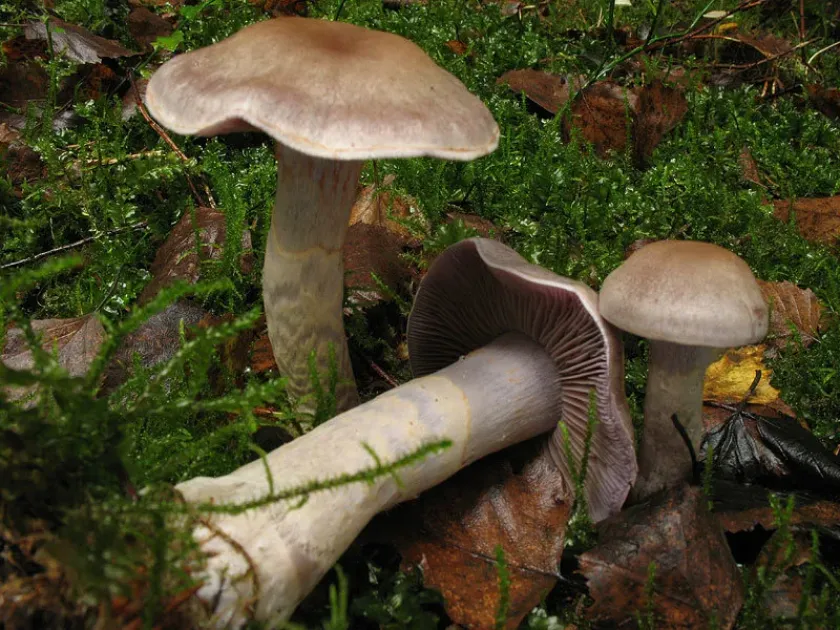
The cap is characterized by a striking blue or azure color, often displaying a fibrillose surface with remnants of the universal veil.
The gills are initially violet-blue, but they eventually turn into a rusty-brown color as the spores mature and deposit onto the surface.
The stem is usually sturdy, often bulbous at the base, and retains evidence of the cortina (the web-like veil) which is covered in rusty spores.
These morphological features help distinguish it from other species within the complex Cortinarius genus.
Pathogen
The azure-veiled webcap (Cortinarius azureovelatus) is a mushroom species within the Cortinariaceae family. It is not a plant pathogen or a disease-causing organism for agricultural crops.
Instead of acting as a parasite, this fungus establishes a symbiotic mycorrhizal relationship with the roots of trees, providing them with essential soil nutrients.
As a basidiomycete fungus, it plays a vital role in decomposing organic matter in forest ecosystems, which is crucial for soil health.
It does not infect crops, grains, or vegetables, and therefore it possesses no agricultural significance in terms of disease control or management.
The biological cycle of the fungus is strictly confined to forest environments where host trees are present to support its mycorrhizal network.
Conditions for development
Growth of the fungal mycelium is dependent on specific forest conditions, such as high moisture levels and cool, sheltered soil environments.
It thrives in soils rich in organic decay, which provides the necessary substrate for the development of its vegetative structure.
The fungus is primarily found in association with tree species that support ectomycorrhiza, requiring a stable, undisturbed forest floor.
Spore dispersal occurs naturally through wind patterns, allowing the fungus to colonize suitable habitats within forest landscapes.
Environmental stability is key to its survival, as the species is sensitive to drastic changes in soil pH and extreme chemical interventions.
Why it matters
The azure-veiled webcap is considered a non-harmful organism; it causes no damage to agriculture or plant health.
In fact, the mycorrhizal association it forms is beneficial to tree health, as it enhances nutrient uptake and resistance to water stress.
There are no reported cases of this fungus causing any decline or yield loss in cultivated plant species.
As a forest-dwelling mushroom, it does not compete with crops for resources and does not create an environment conducive to plant diseases.
Its presence is an indicator of a healthy, functioning forest ecosystem rather than a symptom of an agricultural issue.
Protection
No agricultural control measures, such as fungicides or pesticides, are required or recommended for this species.
Since it does not pose a threat to plant health, management actions are unnecessary and could potentially disturb the beneficial soil ecosystem.
If physical removal is desired for cosmetic reasons in a public park or garden, simple manual harvesting of the fruit bodies is sufficient.
Preservation of the natural habitat is the most appropriate approach, as the fungus is part of a complex and stable biological community.
Agrotechnical strategies should prioritize biodiversity and soil conservation rather than the removal of non-pathogenic fungal species.
Discussion
No discussions yet — be the first.