
Bacidia
Bacidia
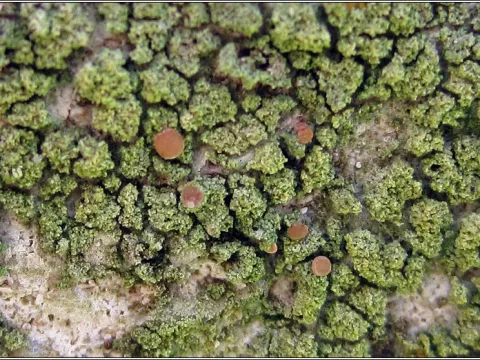
In agronomy and botany, the term Bacidia refers to a genus of lichens that often colonize the bark of trees and shrubs. They manifest as small, flat, or slightly convex crusts, typically gray, greenish, or whitish in color.
What the section contains
Bacidia
Upon closer inspection, one can identify small reproductive structures known as apothecia. These look like tiny, colorful discs, ranging from orange to brown, which are dispersed across the lichen thallus.
These lichens adhere firmly to the bark of trees. They do not penetrate deep into the cambium or wood, making them epiphytes rather than true plant pathogens that consume living plant tissue.
A key sign of colonization is the appearance of a persistent crust on the trunk and older branches. It tends to grow very slowly and is most noticeable on mature trees with rough, textured bark.
The presence of Bacidia is often an indicator of high environmental humidity and stable conditions within an orchard or garden, as well as a reflection of the tree's overall vigor.
Bacidia is a genus of lichenized fungi, which are symbiotic organisms composed of a fungal partner (mycobiont) and an algal or cyanobacterial partner (photobiont). The lichen structure is a result of their mutual interaction.
The mycobiont belongs to the class Lecanoromycetes. It provides the lichen with its structural shape, protects the photobiont from intense sunlight, and manages moisture uptake, which is essential for photosynthesis.
Reproduction is primarily achieved through spores released from the apothecia. These spores are dispersed by wind or water, landing on surfaces where they germinate to form new thalli if conditions are favorable.
Because they do not derive nutrients from the host plant's internal system, they are not considered infectious diseases in the traditional agronomic sense of the word.
Their biological lifecycle is entirely dependent on external environmental stability rather than the health status of the tree they inhabit, though they prefer to colonize surfaces that remain moist for long periods.
The development of Bacidia is favored by high atmospheric humidity and poor air circulation. Overcrowded or unpruned orchard canopies prevent drying, creating an ideal microhabitat for lichen establishment.
Mature trees with rough, cracked, or exfoliating bark are the most common hosts. The crevices in the bark trap spores, moisture, and fine organic debris, providing the perfect nursery for the lichen to thrive.
A lack of regular maintenance, such as sanitation pruning, leads to the deep shade and stagnant air conditions that facilitate the spread of these epiphytes across trunks and scaffold branches.
Environmental air quality plays a role; Bacidia species are often sensitive to sulfur dioxide pollution. Thus, their presence can indicate a cleaner, albeit humid, local environment.
Development is characterized by extreme slowness. It takes many years of stable weather patterns, such as frequent mist or rainfall, for these lichens to form visible, substantial colonies on bark.
The primary concern regarding Bacidia is the ecological niche it provides for pests. The crusty structure of the thallus offers a perfect wintering site for scale insects, aphids, mites, and even pathogens that attack the tree.
While lichens do not consume tree nutrients, a heavy coating may slightly impede gas exchange through the bark lenticels, although this negative impact is usually minimal compared to other stressors.
Their presence is often an aesthetic sign of neglect. In commercial orchards, a trunk covered in lichen might signal that the tree is weak, malnourished, or under-maintained, which correlates with lower overall yields.
No direct chemical damage or necrosis is caused by Bacidia to the plant host. It does not extract sap, nor does it destroy the integrity of the bark cells on its own.
In most cases, the "harm" is psychological and visual for the gardener, as the lichen is often mistakenly identified as a lethal disease, leading to unnecessary and sometimes harsh chemical interventions.
The most effective management strategy is to maintain tree vigor through proper horticultural practices. Regular pruning ensures sufficient light and airflow reach the bark, creating an environment inhospitable to lichen growth.
Mechanical removal is the standard control method. During the dormant season, trunks can be cleaned using stiff-bristled brushes or scrapers, provided the bark is not damaged. All debris must be collected and disposed of.
Whitewashing trunks with lime-based solutions containing copper sulfate is a traditional and highly effective way to prevent lichen colonization and disinfect the bark surface.
- Prune branches to improve light penetration and airflow.
- Mechanically scrape trunks during the dormant season.
- Apply lime-based whitewash to trunks annually.
- Improve tree health through proper fertilization and watering.
Fungicide application for the sole purpose of removing lichens is generally unnecessary. Focus instead on eliminating the primary factors that cause the tree to lose its natural resistance to colonization.