

Description
Symptoms
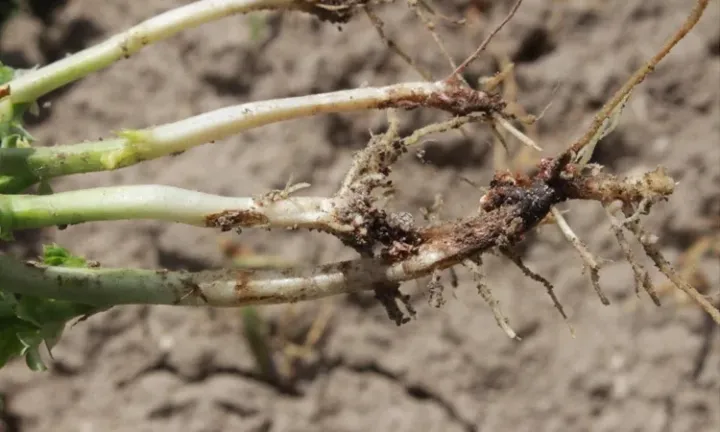
The primary symptom is the browning and softening of root tissues. The roots lose their structural integrity, become water-soaked, and develop a dark brown color due to the breakdown of the epidermis and cortex.
Above-ground, the plant shows classic symptoms of water and nutrient stress, even when soil moisture is adequate. Leaves may wilt, turn yellow, and drop prematurely, a phenomenon most noticeable during hot, sunny hours of the day.
In citrus trees, symptoms often include stunted growth, reduced shoot elongation, and severe chlorosis. In advanced stages, trees cease to fruit entirely and may die within one or two growing seasons.
In seedlings, the disease typically presents as "damping-off," where the stem at the soil line becomes thin and dark, causing the plant to collapse. The root system is usually found to be almost completely decayed at this stage.
In high humidity, a sparse white mycelial growth may appear near the root collar, though the infection is more commonly internal, remaining hidden until the plant significantly deteriorates.
Pathogen
The causative agent of the disease is Globisporangium rostratum, a soil-borne oomycete previously classified within the Pythium genus. It is a microscopic pathogen that persists in the soil as oospores, which are capable of surviving harsh environmental conditions for long periods.
The pathogen affects a wide range of crops, including vegetables, ornamental plants, and various woody species. Among the most vulnerable groups are citrus, where infection of the root system quickly leads to the suppression of the entire tree's vigor.
The biology of Globisporangium rostratum is closely linked to soil moisture levels. The pathogen produces motile zoospores with flagella, which can actively travel through water-filled soil pores, utilizing chemotaxis to detect and reach the roots of potential host plants.
During the invasion process, the oomycete's mycelium penetrates the root tissues, destroying cell walls and absorbing vital nutrients. The infection usually begins in the youngest, most tender parts of the root system, eventually spreading to the primary and secondary roots.
Fungal-like infestations often occur in complex with other soil-borne pathogens, making accurate identification difficult without laboratory analysis and frequently leading to total plant death if left untreated.
Conditions for development
The primary driver of the disease is waterlogged soil. Poor drainage creates an ideal environment for oospore germination and the active migration of zoospores within the soil solution.
Temperature plays a significant role in development; the pathogen is most active under moderately cool or temperate soil conditions, which are common at the start of the growing season or in greenhouses with poor ventilation.
Poor agricultural practices, such as excessive nitrogen application, encourage the growth of soft, succulent roots, making them more susceptible to pathogen penetration. Compacted, poorly aerated soil further facilitates the spread of Globisporangium rostratum.
Infection typically enters through contaminated growing media, poor-quality soil, or infected planting material. Agricultural tools contaminated with infested soil can also act as mechanical vectors for the pathogen.
Weakened plant immunity due to micronutrient deficiencies or concurrent pest attacks (e.g., nematodes) makes plants significantly more vulnerable to the successful colonization of this pathogen.
Why it matters
The severity of the disease lies in the disruption of the plant's ability to absorb water and essential minerals. This leads to energy exhaustion and growth cessation, resulting in direct economic losses for the producer.
Widespread outbreaks in nurseries lead to the loss of a significant percentage of seedlings, necessitating costly replanting efforts and significant delays in production schedules.
In citrus orchards, root rot reduces both total yield and fruit quality. The remaining fruit may be small and lack flavor, while the tree becomes highly sensitive to secondary stresses and environmental changes.
The ability of oospores to survive in the soil for years creates a long-term problem for field management. Infested plots often become unsuitable for susceptible crops for several years without intensive soil fumigation.
In greenhouse operations, contamination of the central irrigation system can lead to rapid transmission of the pathogen to all plants, resulting in total crop loss within a very short period.
Protection
The foundation of effective prevention is strict water management. Installing proper drainage systems and ensuring regular aeration of the soil prevents moisture stagnation near the root zone.
Using certified, disease-free planting material and sterile growing media is critical. Prior to planting, seeds or seedlings should be treated with biological or chemical fungicides to provide initial protection.
Adhering to strict crop rotation practices helps break the pathogen's life cycle. Susceptible crops should not be returned to an infested site for at least 3–4 years, with the inclusion of green manure crops to improve soil health.
The application of biological agents, such as Trichoderma species, helps create a natural barrier against the pathogen and protects developing roots from Globisporangium rostratum invasion.
In cases of severe infestation, the application of specialized fungicides—such as phenylamides or fosetyl-aluminum—is recommended, provided all label instructions and safety regulations are strictly followed.
In brief
1
Affects crops
Biology
Pathogens and affected parts
Affected plant parts
whole plant
Content graph
Affects crops · 1
Content graph
Connections · Root rot
Most often together:
Marketplace
Products · 7


Community
Discussion
No discussions yet — be the first.