

Description
Symptoms
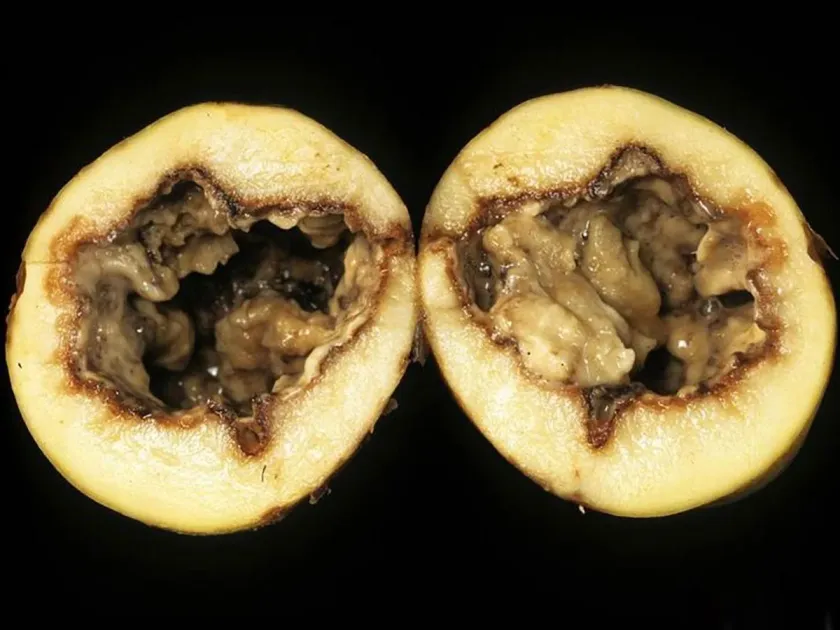
Symptoms often start as small, water-soaked lesions on leaves, stems, or fleshy roots. These lesions rapidly expand into large, soft, and mushy areas.
As the infection progresses, the internal tissues turn into a watery, foul-smelling mass. This distinct smell is a result of the breakdown of cellular components.
In radish and similar root vegetables, the roots can rot from the inside out, often showing minimal external symptoms until the tissue is significantly damaged.
On rapeseed, symptoms may include wilting and stem collapse, as the vascular system becomes disrupted by the rapidly rotting surrounding tissues.
High humidity leads to the development of a bacterial ooze on the surface of infected tissues, which contains massive populations of the pathogen ready for dispersal.
Pathogen
The causative agent of this disease is the Gram-negative bacterium Pseudomonas marginalis. It is a facultative pathogen that survives in soil and crop residues between growing seasons.
The bacterium secretes extracellular enzymes, primarily pectinases, which degrade the middle lamella of plant cell walls, leading to tissue maceration and cell death.
It affects a wide variety of plants, including many vegetables and oilseed crops. Rapeseed and radish are particularly susceptible to this type of bacterial attack.
Transmission occurs through contaminated irrigation water, soil splashes during rain, infected tools, and insect vectors that feed on plant tissues.
Unlike many other bacterial pathogens, Pseudomonas marginalis can maintain high metabolic activity at lower temperatures, making it a persistent threat in cool climates.
Conditions for development
Bacterial soft rot thrives in environments with high relative humidity and poor soil drainage. Waterlogging is a primary trigger for disease outbreaks.
The optimal temperature for the growth and infection process is generally between 15°C and 25°C, though the bacterium remains active in much cooler conditions.
Wounds caused by hail, heavy wind, agricultural machinery, or insect feeding provide easy entry points for the bacteria to colonize plant tissues.
Dense plant canopies that limit airflow and trap moisture create microclimates that are highly favorable for the development of soft rot.
High nitrogen fertilization can lead to succulent plant growth that is more prone to infection and less able to defend against enzymatic degradation.
Why it matters
The disease causes significant economic losses by reducing plant stand density and overall crop yield, especially in vegetable production fields.
Post-harvest losses are extreme, as a single infected root or plant can spread the pathogen to healthy ones during storage and transport.
In rapeseed fields, soft rot infections can lead to premature senescence and death of plants, affecting the quality and quantity of the harvested seeds.
The rapid nature of the infection means that an entire crop can be devastated within a few days under ideal environmental conditions for the bacterium.
The presence of rot often makes the entire batch of harvested vegetables unmarketable, leading to total rejection of the crop by distributors.
Protection
Crop rotation is the most effective cultural practice; avoid planting susceptible crops in succession or on soil with a history of bacterial rot.
Effective sanitation, including the removal and destruction of infected crop debris, is critical to reducing the primary inoculum in the field.
Implementing a strict pest management program is essential, as insects often transmit the bacteria directly into the plant tissues while feeding.
Proper field management, including well-maintained drainage systems to prevent water stagnation and selecting well-drained soil, is essential.
Chemical control options are limited; preventative treatments using copper-based bactericides can help protect plants, but the focus remains on cultural controls.
In brief
2
Affects crops
Biology
Pathogens and affected parts
Affected plant parts
whole plant
Content graph
Affects crops · 2
Content graph
Connections · Bacterial soft rot
Most often together:
Marketplace
Products · 2

Community
Discussion
No discussions yet — be the first.