
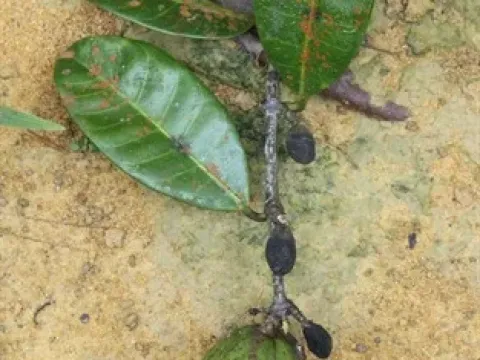
Willughbeia firma
Willughbeia firma
Willughbeia firma is a large, woody liana belonging to the Apocynaceae family, native to the tropical rainforests of Southeast Asia, including Malaysia, Indonesia, and Borneo.
What the section contains
Willughbeia firma
This species thrives in hot, humid climates with high annual precipitation, making it well-suited to the environment of undisturbed equatorial forests.
The plant requires deep, fertile, and well-drained soils to support its vigorous growth, which often involves climbing high into the forest canopy for light.
As a climbing plant, it relies on support structures; therefore, its cultivation in agroforestry systems usually incorporates host trees to facilitate natural development.
The climate must remain stable, with average temperatures consistently above 20 degrees Celsius, as the species does not tolerate temperature fluctuations or drought.
The primary economic output of Willughbeia firma is the milky latex extracted from its stems, which has been historically used as a source of low-grade natural rubber.
In addition to industrial latex, the plant produces edible fruits that are appreciated by local communities, highlighting its potential in diversified agricultural systems.
Harvesting involves carefully incising the bark to collect the sap, a process that requires skill to ensure the plant continues to produce and remains healthy.
Yields vary based on the age of the vine and the availability of nutrients in the soil, with older, thicker-stemmed lianas being the most productive.
By integrating this crop into managed forest landscapes, farmers can produce both food and non-timber forest products in a sustainable, long-term manner.
Deforestation and habitat fragmentation are the primary threats to the long-term survival of Willughbeia firma in its native tropical ranges.
The plant is susceptible to fungal pathogens that enter through wounds, particularly following intensive harvesting activities that damage the cambium layer.
Sucking insects, such as mealybugs and scale insects, frequently target the young shoots, hindering growth and reducing the plant's overall vitality.
Over-exploitation of wild populations for sap collection has led to a decline in density in certain areas, necessitating improved cultivation techniques.
Changes in local microclimates and competitive pressure from invasive weed species can significantly hinder the establishment and growth of young vines.