
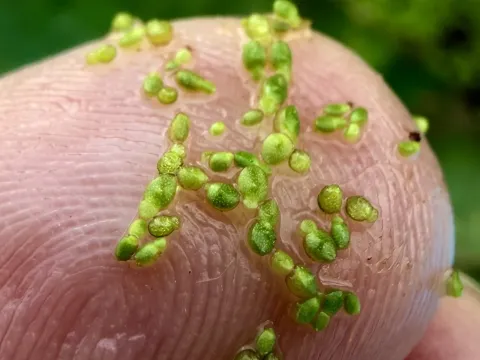
Wolffia papulifera
Wolffia papulifera
Wolffia papulifera, commonly known as watermeal, is a minute, rootless aquatic plant that propagates primarily through vegetative budding. Cultivation begins by introducing a starter culture into a controlled aquatic environment, such as tanks, ponds, or high-tech bioreactors.
What the section contains
Wolffia papulifera
The optimal time for establishing a new colony is when water temperatures consistently exceed 18 degrees Celsius. In greenhouse conditions, cultivation can be maintained year-round, provided that thermal stability is strictly managed.
To begin, the inoculum is evenly spread across the water surface. Given the right conditions—specifically, high light intensity and nutrient availability—the plant quickly colonizes the surface, forming a dense, uniform green mat.
During the establishment phase, it is crucial to minimize turbulence, which can disrupt the floating pattern. A calm water surface allows the plants to maximize light absorption and focus energy on rapid vegetative division.
Once the culture reaches its target density, it enters a phase of constant growth. Managers monitor the colony by checking the vibrancy of the green color; a healthy colony expands its biomass rapidly under ideal nutrient and light inputs.
As a member of the Araceae family, Wolffia papulifera has high nutrient demands. It thrives in water rich in nitrogen, phosphorus, and potassium, which are essential for its rapid synthesis of protein-rich biomass.
The preferred water pH ranges between 6.5 and 8.0. Maintaining this range is critical for nutrient uptake and overall plant health. Deviations from this range can lead to significant drops in growth rates and potential chlorosis.
Thermal requirements are specific; the plant grows fastest at temperatures between 22 and 28 degrees Celsius. Cold stress must be avoided at all costs, as temperatures below 10 degrees Celsius can cause irreversible metabolic damage to the colony.
High light intensity is required for efficient photosynthesis. However, in regions with intense summer heat, artificial shading may be necessary to prevent water overheating and UV stress, which can degrade the chlorophyll content of the plants.
Water quality is of paramount importance. Because Wolffia is an efficient bio-accumulator, the water source must be free of heavy metals and toxins, especially if the resulting harvest is intended for animal feed or human food applications.
Wolffia papulifera is one of the most productive crops on the planet in terms of protein yield per square meter. In high-density intensive farming systems, annual yields can reach up to 20 tons of dry matter per hectare.
The remarkable yield potential is due to the plant's extremely short generation time. Under optimal conditions, the biomass can double every 2 to 4 days, necessitating daily or frequent harvesting schedules to maintain high productivity.
The dry mass is composed of approximately 30-40% high-quality protein, containing a balanced amino acid profile. This efficiency makes it an attractive sustainable alternative to soy-based protein sources for the aquaculture and livestock industries.
Management of population density is vital for maximizing harvest output. Frequent thinning prevents over-compaction, which would otherwise lead to light limitation and oxygen depletion within the lower layers of the mat, reducing overall growth rates.
Economic viability is supported by the relatively low input costs, as the plant does not require soil or complex agricultural machinery. Most operational costs are directed towards water management, temperature regulation, and harvesting labor.
The main biological threats include invasive filamentous algae, which compete for light and nutrients. If left unchecked, these algae can quickly overrun the water surface and stifle the Wolffia population.
Fungal and bacterial infections are common in systems with poor water circulation or stagnant zones. These pathogens can cause necrotic spots and mass decay, necessitating immediate quarantine and water system sanitation.
Certain aquatic insects and mollusks can graze on the Wolffia colonies. In open systems, physical barriers like fine-mesh nets are used to mitigate these risks, while biological controls may be implemented in indoor facilities.
Chemical imbalances, such as rapid salinity fluctuations, can lead to widespread plant mortality. Continuous monitoring of water chemistry is essential to avoid shock to the delicate plant tissues.
Oxygen starvation represents a physical threat to the colony. Regular aeration is necessary to maintain dissolved oxygen levels, preventing the buildup of anaerobic conditions at the water-plant interface, which promotes rot.
Harvesting Wolffia papulifera is a continuous process. Because the plants are so small (less than 2 mm in diameter), harvesting requires specialized fine-mesh nets or automated continuous-flow collection systems designed to capture such minute particles.
After collection, the wet biomass must be thoroughly rinsed in clean, filtered water to remove debris and residual culture media. Cleanliness is a critical quality standard for all end-user applications.
Following the wash, the product undergoes dehydration. Freeze-drying (lyophilization) is the preferred method, as it preserves the essential nutrients, amino acids, and vitamin profile of the plants in their most stable form.
The resulting dried product is a nutrient-dense powder that is highly stable and easy to store or transport. It serves as an excellent additive for specialized diets in poultry, fish, and swine production, and increasingly, as a plant-based superfood.
Packaging must ensure a barrier against light, moisture, and oxygen to prevent the oxidation of lipids. Properly stored, dried Wolffia maintains its high nutritional value for extended periods, meeting international standards for premium feed ingredients.