
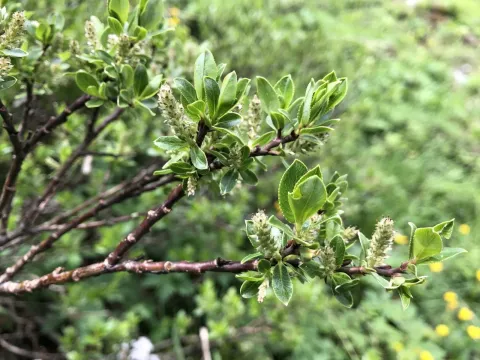
Salix formosa
Salix formosa
Planting Salix formosa is best performed in early spring before active sap flow begins, or in autumn after leaf fall. Propagation via cuttings is the most common method, where 20–30 cm long stems are planted in moist soil.
What the section contains
Salix formosa
For container-grown nursery stock, the planting season is less critical, although the plant's dormant period remains optimal. Ensuring adequate watering during the first few weeks after planting is essential for successful establishment.
When creating living fences or decorative groups, maintain a spacing of at least 1.5 to 2 meters between plants. This prevents competition for nutrients and ensures uniform light distribution for each canopy.
Prepare the planting pit in advance by enriching the substrate with compost or well-rotted manure. If the soil is prone to water stagnation, a drainage layer of sand or gravel should be placed at the bottom.
After planting, mulch the root zone with wood chips, peat, or bark to maintain optimal moisture levels and suppress weeds around the young plant's base.
Salix formosa belongs to the Salicaceae family and is prized for its graceful crown shape. It prefers open, well-lit areas, although it can tolerate light shading during peak sun hours.
The crop is highly demanding regarding soil moisture. It thrives along water bodies, in low-lying areas, or in sites with high groundwater tables where other plants might struggle.
It prefers fertile loamy or sandy soils with a neutral to slightly acidic pH. The plant is sensitive to soil compaction and poor aeration of the root system.
Climate conditions should correspond to temperate zones, as the plant has good winter hardiness but may suffer from sudden temperature fluctuations and strong, desiccating winds.
Care includes regular pruning for crown formation and the removal of dead or damaged branches. During dry periods, abundant watering is required, as moisture deficit negatively affects foliage quality.
The economic use of this crop is primarily decorative and landscape-oriented. Salix formosa is frequently used in urban greening, slope stabilization, and along riverbanks.
In nursery production, yield is defined by the output of high-quality planting material—cuttings or established seedlings ready for sale during the spring and autumn seasons.
The wood of this species is rarely used on an industrial scale, but it can be applied in artisanal basketry and craft projects due to the high flexibility of young shoots.
Plant biomass can be used as a component for mulching after shredding, as willow leaf litter is rich in nutrients that help improve soil structure.
With intensive cultivation for decorative purposes, high crown density can be achieved, increasing the market value of individual specimens sold in garden centers.
Major diseases include willow scab, which manifests as dark spots on leaves and shoots, eventually leading to dieback. Effective control involves spraying with copper-based fungicides.
Powdery mildew often affects the plant under high humidity and poor air circulation within the crown. For prevention, it is recommended to conduct sanitary pruning and avoid overcrowding.
Among pests, leaf beetles are the most dangerous, as they can skeletonize the foliage in a short period. Upon discovery, systemic insecticides of broad-spectrum action are used.
Aphids and spider mites can colonize the underside of leaves, sucking out sap and causing shoot deformation. Treatments should be repeated at 10–14 day intervals until total colony elimination.
Monitoring the bark for damage is crucial, as it may be attacked by boring insects, whose activity weakens the tree and makes it susceptible to secondary fungal infections.