
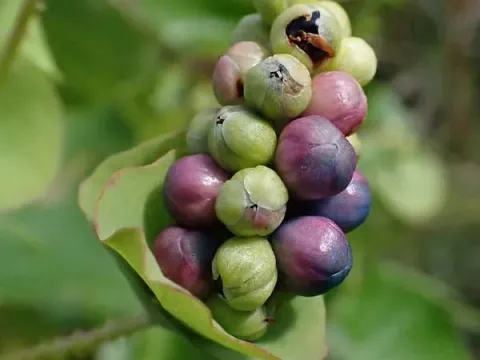
Siebold's knotweed
Polygonum sieboldii
Siebold's knotweed is a perennial herbaceous plant belonging to the Polygonaceae family. Sowing seeds in open ground is typically scheduled for the spring period when the soil warms up to 10–12 degrees Celsius, which ensures uniform emergence of seedlings.
What the section contains
Siebold's knotweed
To speed up the production of seedlings, cultivation in protected ground with subsequent transplanting to a permanent location is permitted. The seeds require pre-sowing stratification, which significantly increases their germination rate.
The optimal planting pattern should account for the intense root system development of this plant. Usually, an interval of at least 60–80 centimeters is left between rows, allowing the culture to develop fully during the growing season.
For propagation on commercial plantations, vegetative division of the root clump is often used. This allows for the preservation of varietal characteristics and speeds up the acquisition of merchantable biomass in the first year after planting.
The seeding depth should not exceed 1–2 centimeters. If the topsoil dries out, moderate watering must be provided to prevent the loss of seedlings at early developmental stages.
The crop prefers sunny areas protected from strong winds, although it can tolerate light shading during the hottest time of the day. The plant is quite demanding regarding substrate humidity, so areas with a high water table are most suitable.
Siebold's knotweed grows best in fertile loamy soils with a neutral or slightly acidic pH. Good drainage is essential to prevent water stagnation, which can lead to root rhizome decay.
During the active growth period, the crop requires regular fertilization with nitrogen-containing fertilizers. Starting from the second half of summer, nitrogen dosage should be reduced in favor of phosphorus-potassium compositions to prepare the plants for winter.
Climate requirements include moderate winter hardiness. In northern regions, the plant may require the covering of the root zone with mulch (peat, sawdust, or spruce branches) to prevent the root system from freezing.
The culture has high growth energy and rapidly builds up vegetative mass. It responds well to inter-row cultivation, which promotes better air penetration to the roots and suppresses weed development.
The main indicator of yield is the biomass of the plant's above-ground part, which is actively used in pharmacology and landscape design. Maximum productivity is reached in the 3rd year of the plantation's life under appropriate agricultural management.
With proper care, green mass harvesting can be performed twice per season. The first cut is performed during the mass flowering period when the concentration of biologically active substances in the plant tissues reaches peak values.
A second cut is possible at the end of summer, provided there is sufficient soil moisture and complete recovery of the bush. Do not harvest too late, as the plant needs time to accumulate nutrients in the rhizome before winter.
Storage of raw materials requires strict temperature control and low air humidity. Drying is carried out in well-ventilated rooms or specialized dryers at temperatures not exceeding 45 degrees Celsius.
Economic efficiency of cultivation depends directly on planting density and soil fertility quality. On average, several tons of dry plant raw material can be obtained from one hectare using intensive farming methods.
Siebold's knotweed has a fairly strong immune system, but under excessive moisture conditions, it is prone to fungal infections such as powdery mildew or leaf spot. Main prevention consists of maintaining aeration and controlling planting density.
Pests typical for Polygonaceae may damage young leaves. These include aphids and various types of herbivorous mites. Biological insecticides or plant-based phytopreparations are used for control.
Slugs can pose a threat to young plants during rainy periods. It is recommended to create protective barriers from wood ash or use traps to limit pest access to the plantation.
Root rot is the most dangerous disease caused by violations of agricultural techniques. Infected specimens should be immediately removed from the plot along with a root ball of soil to prevent the spread of infection to neighboring plants.
Adhering to crop rotation is an important factor in controlling the phytosanitary state. It is not recommended to plant knotweed on plots where other members of the Polygonaceae family have been grown within the last three years.
Harvesting begins with mowing the above-ground part, leaving 5–10 centimeters of the stem above the soil level. Using a sharp tool allows for avoiding damage to the renewal buds located at the base of the bush.
The collected mass must be promptly sent for primary processing. Delaying drying leads to the loss of essential oils and a decrease in the quality of the medicinal raw material, which is critical for subsequent pharmaceutical use.
During the harvest, the raw material is sorted, removing damaged or diseased parts of stems and leaves. Cleaning from weed vegetation at the harvesting stage saves time during subsequent production processing.
Knotweed rhizomes can be harvested in autumn when the above-ground part of the plant completely dies off. Digging is carried out mechanically, followed by washing in running water and soil removal.
After harvesting, the plantation must be cleared of plant residues, deep soil cultivation performed, and organic fertilizers applied. This ensures a full recovery cycle of the crop for stable yields in the future.