
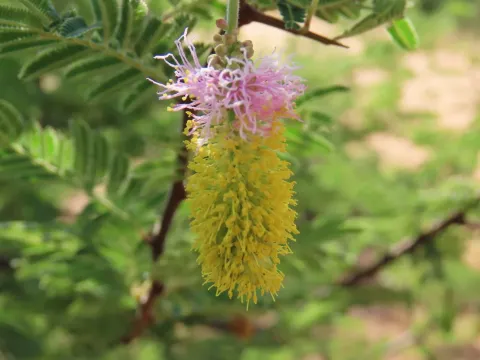
Sicklebush
Dichrostachys nutans
Sicklebush (Dichrostachys nutans) is a perennial shrub belonging to the Fabaceae family. It is native to tropical regions of Africa, Asia, and northern Australia.
What the section contains
Sicklebush
The plant is highly drought-tolerant, thriving in arid environments where water scarcity prevents the growth of more sensitive agricultural species.
It prefers well-drained soils and is capable of surviving in nutrient-poor conditions, often acting as a pioneer species for ecological restoration.
As a legume, it fixes nitrogen, which plays a vital role in soil enrichment, making it an excellent candidate for sustainable agroforestry systems.
It requires ample sunlight and is well-adapted to hot climates with prolonged dry seasons, showing minimal response to seasonal temperature fluctuations.
Sicklebush is primarily valued for its dense, high-quality wood, which burns slowly and produces significant heat, making it an ideal source of charcoal.
The foliage and protein-rich pods serve as essential fodder for livestock, particularly in regions where seasonal grazing resources become limited.
The plant is an excellent source of nectar, supporting local apiculture and honey production throughout the flowering periods of the dry season.
Farmers often utilize the shrub to establish natural boundaries or live fences, which help mitigate soil erosion and protect crop fields from wind damage.
Traditional medicinal applications of its bark and roots add to its economic value, supporting livelihoods in diverse tropical agricultural communities.
Sicklebush exhibits remarkable resistance to common plant diseases and pests, largely due to its robust chemical defenses and rapid regeneration capabilities.
While not prone to severe infestation, the plant can become invasive if not managed, outcompeting native grasses and reducing pasture carrying capacity.
Fungal issues are rare and typically restricted to waterlogged areas where poor soil drainage allows root pathogens to develop.
No major pest outbreaks currently threaten the stability of the crop, as its thorns and plant architecture provide physical barriers to many herbivores.
Sustainable land management practices, including periodic trimming and controlled grazing, are sufficient to prevent the plant from becoming a problematic weed.