
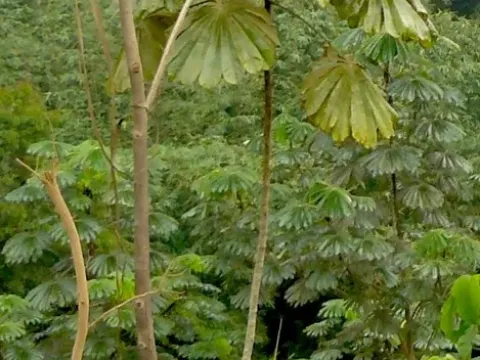
Musanga
Musanga
Propagation of Musanga (specifically Musanga cecropioides) in natural settings occurs via seeds dispersed by birds and small mammals. In agricultural practices, seeds are sown in specialized nurseries using a lightweight, well-draining substrate while maintaining high humidity.
What the section contains

Musanga
Musanga seeds exhibit high germination rates but require the removal of the pericarp to accelerate the process. Seedlings typically emerge within 2–3 weeks under a stable temperature range of 25–28 degrees Celsius.
Once the saplings reach a height of 30–40 centimeters, they are transplanted to their permanent location. Protecting young plants from intense direct sunlight and competing weeds is essential for successful establishment.
Planting in open ground is best performed at the beginning of the rainy season to allow the root system to adapt before the dry season. Planting density is determined by the specific objective, such as biomass production or timber harvesting.
Aftercare for young cultures involves regular weeding around the base and mulching to retain soil moisture, which is critical for supporting the rapid growth cycles characteristic of this species.
Musanga is a member of the Urticaceae family and acts as a pioneer tree species in equatorial African rainforests. It thrives in humid, tropical climates with annual rainfall exceeding 2000 millimeters and no distinct dry season.
The culture requires fertile, well-draining soils for optimal development. Despite its preference for moisture, the plant is sensitive to waterlogging, necessitating proper soil management on heavy clay terrains.
As a light-demanding pioneer species, Musanga rapidly colonizes open areas cleared by logging or fire. Growth is significantly stunted or halted in heavy shade, making open light exposure a prerequisite for health.
The optimal temperature range for vegetation is between 22 and 30 degrees Celsius. The species cannot survive frost, thus limiting its geographical cultivation range exclusively to tropical regions.
Due to its rapid biomass accumulation, the plant demands consistent access to soil nutrients. In cases of depletion or chlorosis, nitrogen fertilization is recommended to maintain vigorous development.
Musanga is recognized as one of the fastest-growing tropical tree species. In just a few years, it can reach heights of 10–15 meters, generating a significant volume of lightweight, soft timber suitable for various industrial applications.
Biomass yields are exceptionally high. Because of its intense photosynthetic activity, the plant produces substantial leaf mass, which, if used for mulching, contributes significantly to soil organic matter content.
The wood of Musanga is light and porous, often compared to balsa. It is widely used in local construction, the production of floats, lightweight packaging materials, and as a feedstock for the pulp and paper industry.
Various parts of the tree, including the fruit, are edible or used in traditional medicine. The fruit serves as a valuable food source for local wildlife and contributes to the biodiversity of the agroforestry ecosystem.
Under plantation management, the harvest cycle is approximately 7–10 years. Upon reaching maturity, the timber is ready for technical processing, and the area can be easily replanted due to the tree's regenerative nature.
While robust, Musanga is susceptible to specific tropical pathogens when cultivated under poor management. Root rot caused by fungal infections, often resulting from waterlogged conditions, poses the most significant threat.
Various insect pests, including certain caterpillars and weevils, can damage foliage and young shoots, potentially reducing growth rates and weakening the overall vitality of the plantation.
Stem-boring pests can infect adult trees through damaged bark. Periodic monitoring and the removal of infected individuals are essential to prevent the spread of infestations across the planting area.
Parasitic plants, such as mistletoe, may colonize the crowns of mature trees, drawing nutrients and causing branch dieback. Regular pruning and cleaning are necessary to mitigate this risk.
Continuous monocropping can lead to an accumulation of soil-borne pathogens. Agronomists recommend rotating planting sites and implementing sanitary clearing measures after each harvest cycle to ensure long-term soil health.