
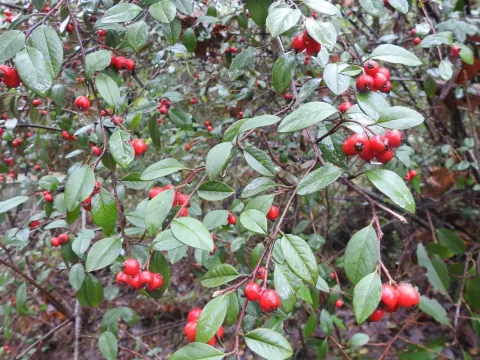
Cotoneaster
Cotoneaster Medik.
Cotoneaster (Cotoneaster Medik.) is a diverse genus of woody plants belonging to the family Rosaceae. Originating from the temperate regions of Eurasia and North Africa, these shrubs range from prostrate ground-hugging forms to large, upright bushes.
What the section contains
 Bearberry cotoneaster
Cotoneaster dammeri C.K. Schneid.
Cotoneaster dammeri
Cotoneaster dammeri C. K. Schneid. var. radicans Dammer ex C. K. Schneid.
Bearberry cotoneaster
Cotoneaster dammeri C.K. Schneid.
Cotoneaster dammeri
Cotoneaster dammeri C. K. Schneid. var. radicans Dammer ex C. K. Schneid.
 Cotoneaster praecox
 (Bois et Berthault) M. Vilm.
Cotoneaster praecox
Cotoneaster praecox (Bois et Berthault) M. Vilm.
 Creeping cotoneaster
Cotoneaster procumbens G. Klotz
Creeping cotoneaster
Cotoneaster procumbens G. Klotz
 Franchet's cotoneaster
Cotoneaster franchetii Bois
Franchet's cotoneaster
Cotoneaster franchetii Bois
 Rock cotoneaster
Cotoneaster horizontalis Decne.
Rock cotoneaster
Cotoneaster horizontalis Decne.
 Swedish cotoneaster
Cotoneaster x suecicus G. Klotz
Swedish cotoneaster
Cotoneaster x suecicus G. Klotz
 Tibetan cotoneaster
Cotoneaster conspicuus H. F. Comber ex C. Marquand
Tibetan cotoneaster
Cotoneaster conspicuus H. F. Comber ex C. Marquand
Cotoneaster
The culture is highly valued for its adaptability. Cotoneaster plants thrive in a wide range of soil types, provided there is adequate drainage. They are particularly resilient in alkaline and neutral soils, often proving to be hardy on rocky or disturbed sites where other species struggle.
Climatic requirements are moderate; most varieties are exceptionally cold-hardy and demonstrate high tolerance to drought once established. These traits make them an excellent choice for urban landscapes, as they resist both pollution and wind-swept environments effectively.
Optimal growth is achieved in full sun to partial shade. While sun exposure encourages denser foliage and a more prolific display of red or black berries, the plants remain relatively robust even in shadier garden spots, though they may become more leggy.
Agrotechnical management is minimal. Key tasks include annual spring pruning to remove dead or diseased branches and to maintain the desired shape. Fertilization is generally not required unless the plant is growing in extremely nutrient-depleted soil.
Common pests affecting Cotoneaster include aphids, lace bugs, and various species of mites. These insects typically target the undersides of the leaves or young succulent shoots, leading to curling and general chlorosis.
Disease pressure is most significant regarding fungal infections like leaf spot and powdery mildew. These issues often arise during periods of high humidity and poor air circulation within the shrub canopy.
Fire blight (Erwinia amylovora) is a critical concern, as Cotoneaster belongs to the Rosaceae family. This bacterial disease can cause sudden wilting and blackening of the foliage and stems, necessitating immediate sanitation measures.
Integrated pest management strategies involve thinning the canopy to allow for airflow, which reduces fungal development. Proper site selection and avoiding overhead irrigation can also significantly lower the risk of infection.
Chemical control, including the application of fungicides and horticultural oils, should be used selectively. Always monitor for early warning signs to prevent the spread of diseases and maintain the long-term health of the hedge or shrub.