
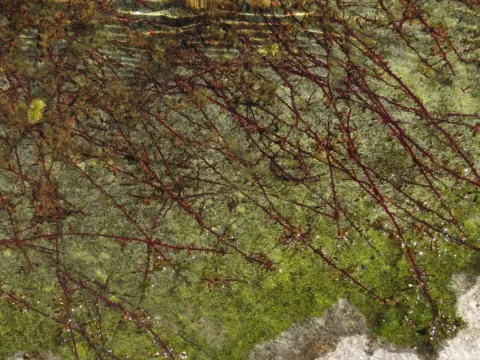
Cladopus
Cladopus
Cladopus is a fascinating genus of flowering plants belonging to the family Podostemaceae. These plants are specialized rheophytes, meaning they are evolutionary adapted to live in fast-flowing water environments, primarily in tropical and subtropical regions of Asia.
What the section contains

Cladopus
The plants possess a highly distinct morphology, characterized by a thallus-like structure that adheres firmly to submerged rocks. This attachment is achieved through flattened discs or haptera, which prevent the plant from being swept away by the river's current.
In terms of environmental requirements, Cladopus thrives only in high-quality, oxygen-rich freshwater. They are highly sensitive to water chemistry, temperature, and light transparency, making them an excellent bioindicator for river health.
Unlike conventional agricultural crops, these plants do not require soil or fertilizers; they absorb all necessary nutrients directly from the water column. Their reproductive phase often triggers as water levels recede, allowing the flowers to bloom in the air.
Botanists study Cladopus to understand extreme plant adaptation. They do not have traditional root systems or leaves, which allows them to minimize drag against the powerful water forces found in their mountain stream habitats.
The most significant threat to Cladopus populations is the construction of dams and other hydropower infrastructure. These projects alter the natural water flow, siltation, and oxygenation levels, which are critical for the plant's survival.
Agricultural runoff containing herbicides and fertilizers poses a major risk. Even minor changes in nutrient levels can encourage the overgrowth of competing algae, which outcompete Cladopus for space and sunlight.
Deforestation along river banks leads to increased soil erosion and water turbidity. When the water becomes murky, the plant's photosynthetic capacity is severely hindered, leading to stunted growth or death.
Climate change, manifesting as prolonged droughts or unpredictable flood events, disrupts the delicate timing required for the life cycle of Cladopus. Changes in the duration of submersion and exposure are often fatal.
Physical disturbance of riverbeds, such as dredging or aggregate mining, destroys the rocky substrate required for the plant's colonization. Once the host rocks are moved or covered, the local population of this plant is lost.