
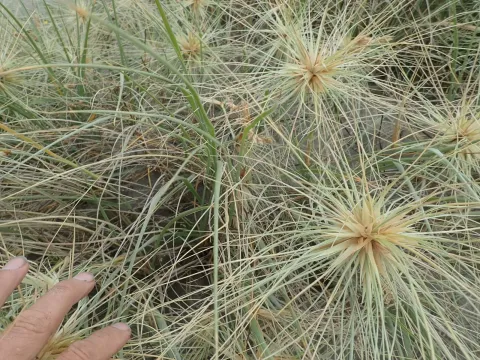
Spinifex
Spinifex
Spinifex is a genus of perennial grasses belonging to the Poaceae family. In their natural environment, these plants propagate primarily through wind-dispersed seeds, which move like tumbleweeds across coastal sands, or vegetatively via rooting stolons.
What the section contains


Spinifex
For agricultural or ecological restoration purposes, such as dune stabilization, seeds are typically sown at the end of the dormancy period, just before the rainy season begins. This timing ensures sufficient moisture for germination and rapid establishment in the sandy substrate.
The sowing depth must be minimal because the small seeds of this wild grass struggle to emerge from deep soil layers. Surface sowing followed by a light layer of mulch is considered the optimal technique to protect seeds from being blown away by coastal winds.
Planting density is determined by the specific goals of the project; for erosion control, higher densities are preferred to create an interconnected network of roots as quickly as possible across the sandy surface.
In professional agronomy, seed stratification is sometimes employed to overcome natural dormancy in the embryo, ensuring uniform germination rates and higher success in harsh coastal soil conditions.
Spinifex is a specialized xerophyte and psammophyte, perfectly adapted to the extreme conditions of maritime environments. It requires open, high-light areas and cannot tolerate shading from taller vegetation or canopy cover.
The crop is highly tolerant of low soil fertility and thrives on nutrient-poor, saline sand dunes. It possesses a deep, extensive root system that enables the plant to access moisture from subterranean aquifers during prolonged droughts.
This grass exhibits remarkable resilience against salt spray and high-velocity coastal winds. It is primarily found in tropical and subtropical regions, as it is highly sensitive to frost and cannot survive in colder climates.
Fertilizer requirements are negligible, as Spinifex has evolved to efficiently capture and cycle nutrients from organic matter deposited by tides and trapped within the moving sand particles.
Soil aeration is the most critical environmental factor for this species. Spinifex does not tolerate waterlogging or compacted soils, which is why its natural habitat is strictly restricted to loose, sandy dunes and coastal flats.
The most significant threat to Spinifex populations is overgrazing by livestock, which consumes the vegetative biomass and compromises the root structure, ultimately exposing dunes to severe wind erosion.
While diseases are rare in the wild, artificial cultivation in enclosed or poorly ventilated nurseries can lead to fungal infections triggered by excessive humidity levels in the surrounding air.
Pests, such as various lepidopteran larvae or grasshoppers, may feed on the foliage, but widespread outbreaks are rare due to the high silica content in the plant's tissues, which acts as a natural mechanical deterrent.
Anthropogenic disturbances, including pedestrian foot traffic and off-road vehicle use on beaches, cause massive damage to Spinifex colonies. Physical disruption of the stolons often leads to the death of entire clusters.
Invasive weed species can also pose a competition threat during the plant's active growth phase, particularly if the local hydrological conditions are altered by human infrastructure projects.
Spinifex is not an agricultural crop in the traditional sense, as it is not harvested for food or fiber production. Harvest activities are generally limited to collecting seed heads for ecological restoration projects.
Seeds should be collected once they have fully matured and the flower heads turn a characteristic straw color. It is crucial to perform the collection in dry weather to prevent premature germination or fungal decay during storage.
In commercial settings, it is often more effective to harvest vegetative fragments, such as rhizome sections and stolons, during the peak growing season for direct transplanting into stabilization sites, as this ensures a higher survival rate than seed sowing.
Harvesting tools must be sharp and clean to prevent excessive damage to the mother plant, especially when selective harvesting is employed to maintain the long-term health of the parent population.
Once harvested, either seeds or vegetative cuttings must be planted immediately or stored in controlled environments that mimic natural conditions to preserve the biological viability of the plant tissues.