
Spinifex littoreus
Spinifex littoreus
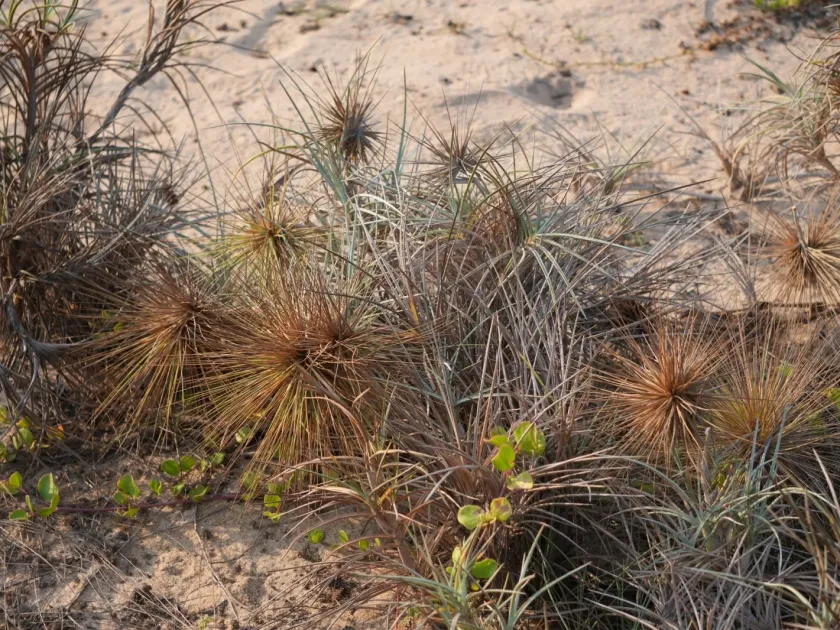
Description
Sowing dates
Spinifex littoreus is a perennial grass species belonging to the Poaceae family, specifically adapted for survival in harsh coastal environments. Its unique reproductive strategy involves wind-dispersed seed heads.
For agricultural purposes or coastal management, the preferred method of propagation is vegetative planting using rhizome segments. This ensures faster establishment on shifting sands compared to using seeds.
When sowing seeds, they should be placed at a shallow depth of approximately 2-3 centimeters. Deeper planting often results in poor germination due to the energy constraints of the seedling reaching the surface.
The timing of sowing must coincide with the beginning of the rainy season. This ensures that the root system has enough time to establish itself before the onset of extreme heat and dry spells.
Proper density and spacing are crucial; plants should be set in patterns that optimize sand trapping while allowing room for lateral rhizome growth.
Growing requirements
This species thrives in pure sandy soils and is highly adapted to high salinity environments. It requires a free-draining substrate to prevent root rot and promote healthy gas exchange.
Spinifex littoreus requires full sun exposure and cannot survive in shaded areas. Light intensity is a primary limiting factor for its photosynthetic capacity and overall biomass production.
The climate must be tropical or subtropical. The plant is extremely frost-sensitive and will not survive temperatures approaching zero, restricting its geographic distribution.
While known for its drought resistance, it relies on deep-seated moisture within the sand dunes. Access to water via deep root systems allows it to persist even in arid coastal regions.
Minimal soil nutrient requirements make it an excellent choice for colonization of barren sand dunes where other vegetation types would typically struggle to establish.
Yield
The "yield" of Spinifex littoreus is measured by its capacity to fix sand dunes and prevent coastal erosion. In ecological engineering, its value lies in the amount of soil stabilized per hectare.
The plant produces a dense network of foliage and roots that effectively traps wind-blown sand. This accumulation builds up the dune structure, enhancing coastal resilience against storm surges.
Beyond its stabilizing role, the fibrous biomass of mature plants has traditional uses in handicraft production, such as weaving mats and household implements.
Productivity peaks when the plant reaches maturity, usually within two to three years of cultivation. At this stage, the vegetative cover is densest and most effective at soil retention.
In terms of forage, it is generally considered low-quality due to the high silica content and toughness of the leaves, limiting its utility for livestock farming.
Main diseases and pests
Rust diseases represent the most significant pathological threat, particularly during seasons with high humidity, which can lead to leaf decay and reduced vigor.
Insects, particularly larvae, can damage stems and floral structures. This herbivory can lead to reduced seed production and weakened mechanical resistance against wind forces.
Overgrazing by local fauna can destroy young, tender shoots. Without protection from herbivores, successful stand establishment in vulnerable areas is nearly impossible.
Human interference, such as beach traffic and unauthorized paths, is a primary driver of plant loss. Mechanical destruction often leads to blowouts in the stabilized dunes.
Invasive species encroachment is a major challenge; aggressive weeds can quickly outcompete Spinifex in disturbed areas, leading to a decline in local ecological health.