
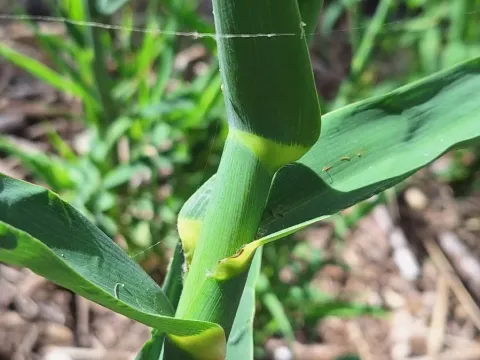
Giant reed
Arundo L.
Giant reed (Arundo donax) is a perennial grass typically propagated through vegetative means, such as rhizome sections or stem cuttings, rather than seeds. The most suitable time for establishing a plantation is early spring once the soil temperature consistently reaches 10–12°C.
What the section contains

Giant reed
Planting material is usually placed in furrows at a depth of 10 to 15 centimeters. Ensuring good contact with moist soil is crucial during the initial stages to facilitate the development of the primary root system and the subsequent shooting of new culms.
In large-scale cultivation, rows are spaced approximately 80 to 100 centimeters apart. This spacing is designed to accommodate standard agricultural machinery, which is essential for managing the crop during the first growing season before it reaches full canopy closure.
Fall planting is generally avoided, as young shoots are highly vulnerable to frost damage before they establish a deep and resilient root system. Proper timing ensures that the plant allocates energy to underground growth before winter dormancy.
Arundo exhibits high vigor and rapid regeneration. Once established, it forms a dense network of rhizomes, making the crop highly competitive and capable of maintaining a consistent stand density for many years.
As a member of the Poaceae family, Arundo donax is recognized as one of the most productive biomass crops globally. It thrives in sunny locations with high solar radiation, which is essential for maximizing its photosynthetic rate and dry matter accumulation.
The plant is highly adaptable to various soil types but performs best in deep, well-drained alluvial soils. It shows remarkable tolerance to salinity and can be utilized effectively for the rehabilitation of degraded or marginal lands that are unsuitable for traditional food crops.
Water availability is the primary factor limiting the yield of Giant reed. While adult plants display significant drought tolerance, supplemental irrigation during the peak growing season can substantially increase the final biomass output.
Arundo requires a temperate or subtropical climate. Although the rhizomes can withstand temperatures below freezing, the above-ground biomass is sensitive to hard frosts, which terminate the vegetative phase and trigger the onset of the dormant period.
High biomass production rates necessitate adequate nutrient availability. Periodic application of nitrogen-based fertilizers is beneficial for maintaining long-term stand productivity and supporting the rapid vertical growth of the culms.
The yield potential of Giant reed is exceptional, with some managed plantations producing between 30 and 50 metric tons of dry biomass per hectare annually. This high productivity makes it a prime candidate for renewable energy and bio-based industrial applications.
Maximum yields are typically achieved from the third year onwards, once the rhizome system has fully matured. The plant's ability to utilize solar energy efficiently allows it to outperform many other conventional energy crops in terms of total dry matter produced per hectare.
Yield stability is dependent on the management regime, including the frequency of irrigation and the soil fertility levels. When well-managed, an Arundo plantation can remain productive for 15 to 20 years without the need for replanting.
The culms of Arundo are rich in cellulose, providing high-quality feedstock for pulp and paper manufacturing, as well as for the production of second-generation biofuels and bio-composites.
Economic viability is driven by its high yield, which allows farmers to generate consistent revenue from land that might otherwise be underutilized, providing a stable source of feedstock for the green energy sector.
Giant reed is notably resilient and rarely suffers from major pest or disease outbreaks that would jeopardize the entire plantation. Its natural vigor provides a strong defense against many common agricultural pathogens.
While occasional infestations of aphids or leaf-feeding insects may occur, they rarely reach economic threshold levels that would necessitate the application of insecticides or other chemical control measures.
Root rot, caused by poor drainage or waterlogged conditions, is the most common health issue for Arundo. Maintaining proper soil moisture and ensuring good drainage are key to preventing the development of fungal pathogens in the rhizome system.
Weed control is a concern only during the first year of establishment. Once the plants reach maturity, the density of the growth and the rapid accumulation of biomass effectively shade out competing vegetation, eliminating the need for herbicides.
The most significant concern associated with Arundo is its potential to be invasive. In certain ecosystems, it can spread beyond the boundaries of the field, requiring vigilant monitoring and management to prevent it from becoming an environmental nuisance.
Harvesting is performed at the end of the growing season when the culms reach physiological maturity and their moisture content naturally decreases. This usually occurs in late autumn or early winter, depending on the local climate.
Modern forage harvesters or modified silage choppers are typically used to cut and shred the biomass in a single pass. This process is efficient and prepares the feedstock for immediate transport or storage in pelletizing facilities.
It is recommended to leave a stubble height of about 15–20 centimeters. This acts as a protective layer for the rhizomes during winter and ensures that the plant has enough energy reserves to initiate strong regrowth in the spring.
Timing the harvest correctly is essential to optimize biomass moisture levels. Harvesting when the material is drier reduces transportation costs and energy inputs required for drying, significantly improving the net energy balance of the product.
Post-harvest management is minimal, as the plantation enters winter dormancy. The system's ability to regrow from existing rootstocks annually eliminates the need for repeated tillage or seeding, further reducing operational costs.