


Reference · Crops
Marsh mallow
Althaea
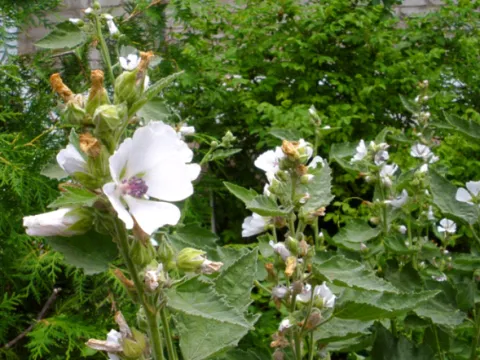
Marsh mallow (Althaea officinalis) is typically sown in early spring once soil temperatures reach 10–12°C. The seeds of this perennial, belonging to the Malvaceae family, have a hard coat, often requiring scarification or a 24-hour soak to improve germination rates.
3
items
What the section contains
Marketplace
Products in this section · 4


Biofungicide Mikosan «B» and «N», 3% w/v
Mykoton-Aglicon, LLC
Fungicides
0
0
9 offers
3.58 €per 1 l
Buy

Marsh mallow
Seeds should be planted at a depth of 1.5–2 cm. When planting in rows, spacing is maintained at 60–70 cm to provide enough room for the plants to establish their substantial root systems during the first year of growth.
Germination is slow, so maintaining consistent soil moisture is crucial during the initial stages. Once seedlings develop 2–3 true leaves, thinning is performed to space individual plants 20–30 cm apart.
Late autumn sowing is also practiced in some regions, allowing seeds to undergo natural stratification over the winter. This often results in more vigorous spring growth as the plants benefit from early season soil moisture.
As a long-term perennial crop, site selection is vital. The field should be prepared to support plants for several years, as the primary objective is root production, which accumulates mass over multiple growing seasons.
Marsh mallow thrives in open, sunny locations with fertile, well-drained loamy or sandy soils. It is sensitive to waterlogging; therefore, avoid low-lying fields where water might accumulate, as this causes root decay.
The plant performs best in soils with a pH range of 6.0–7.5. Nutrient-rich soil is essential for maximizing the yield of roots, which are the main source of the pharmacologically active polysaccharides and mucilage.
Clean fields with minimal perennial weed pressure are preferred, as early competition can significantly stunt the growth of young marsh mallow plants. Proper site preparation, including deep plowing, is recommended before planting.
Regular cultivation between rows is necessary to keep the area free of weeds and to prevent soil crusting. Aeration is important for root development, particularly in heavier soil types where oxygen penetration can be limited.
While the crop is relatively hardy, supplemental irrigation during dry periods, especially in the first year, significantly enhances plant vigor. Once established, the plants are quite resilient and can tolerate various climatic fluctuations.
The primary harvest cycle for marsh mallow roots is the second year of growth. Harvesting at this stage ensures the highest concentration of active mucilaginous compounds, which are the hallmark of the crop's quality.
Typical yields for dried roots range from 1,500 to 2,500 kg per hectare, depending on soil quality, plant density, and the implementation of sound agronomic practices such as fertilization and irrigation.
The crop offers dual value, as leaves can also be harvested during the flowering stage. This adds to the overall economic efficiency of the farm, providing secondary products without compromising the primary root crop.
Yield quality is determined by the processing speed. Roots must be washed and processed immediately upon extraction from the soil to ensure that the mucilage remains intact and free from fermentation.
Effective management involves monitoring plant density. Overcrowding can lead to smaller roots, whereas proper spacing ensures high-quality, uniform product that meets industry standards for botanical raw materials.
Rust (Puccinia malvacearum) is the most prevalent disease, manifesting as brown spots on the foliage. It can severely limit photosynthesis, ultimately leading to reduced starch accumulation in the plant roots.
Powdery mildew also frequently affects marsh mallow, particularly in humid or stagnant air conditions. Proper row spacing and field sanitation are effective preventative measures to reduce the incidence of these fungal infections.
Pests like aphids and spider mites can infest the leaves, sucking sap and weakening the plant. Integrated pest management (IPM) strategies, including biological controls, are preferred to maintain the medicinal quality of the crop.
Root rot represents a significant threat to overall crop viability. Since the root is the marketable commodity, preventative drainage management is essential to protect the harvest from fungal or bacterial decay.
Regular field scouting is necessary to identify early signs of infestation or disease. By acting swiftly with approved treatments, producers can minimize crop damage and maintain healthy yields across the entire plantation.
Root harvesting is conducted in the autumn of the second year when the aerial parts of the plant begin to yellow and wither. This is the biological indicator that the plant has redirected resources to the roots.
Mechanical diggers are used to extract the roots from the soil. Once lifted, roots are promptly cleaned and washed to remove soil, as dirt particles can introduce contaminants and degrade the shelf-life of the final product.
Drying must be performed in controlled conditions at 40–50°C. Inadequate drying temperatures or excessive ambient humidity can lead to the growth of mold, which would render the entire harvest unsalable.
Leaves are collected when the plant is in full bloom. They are spread out in thin layers in shaded, well-ventilated areas to ensure they retain their natural green color and high mucilage content.
After processing, the material should be stored in a cool, dry place. Proper packaging is required to shield the product from moisture and pests, ensuring the quality remains stable until the product reaches the manufacturer.