
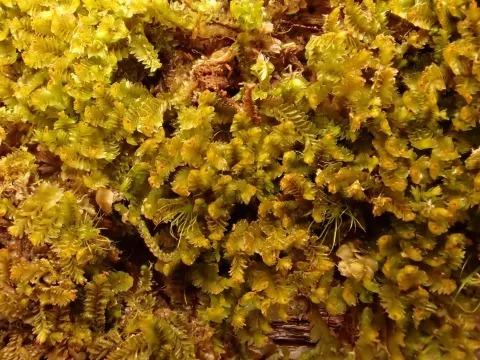
Tritomaria exsecta
Tritomaria exsecta
Tritomaria exsecta is a liverwort species belonging to the Jungermanniaceae family. It is not an agricultural crop but a significant bryophyte found in forest environments, primarily throughout the Northern Hemisphere's temperate and boreal regions.
What the section contains
Tritomaria exsecta
The plant is typically found in coniferous and mixed forests. It displays a preference for damp, shaded micro-habitats, often colonizing decaying logs, peat-rich soil, or moist rock surfaces protected from extreme desiccation.
Botanically, it forms small, dense mats characterized by leaves that are deeply divided into lobes. Its pigmentation is highly responsive to environmental factors, shifting between green and reddish-brown depending on the intensity of light exposure.
Its ecological requirements are strict, necessitating high levels of humidity and acidic, stable substrates. Unlike commercial crops, it cannot survive in managed farmland environments, as it requires the specific microclimate provided by intact forest canopies.
In terms of usage, the species serves as a critical component of forest floor biodiversity. It aids in moisture retention and soil organic matter decomposition, and it is widely studied by botanists as a bioindicator of air quality and habitat health.
The primary threats to the survival of Tritomaria exsecta involve habitat loss caused by deforestation and large-scale timber extraction. The removal of coarse woody debris, which serves as its primary substrate, significantly reduces population density.
Atmospheric pollution, particularly acid rain and sulfur compounds, can severely damage the reproductive tissues of the moss. Furthermore, climate change, specifically altered precipitation patterns, poses a long-term risk to its specialized moisture-dependent life cycle.