
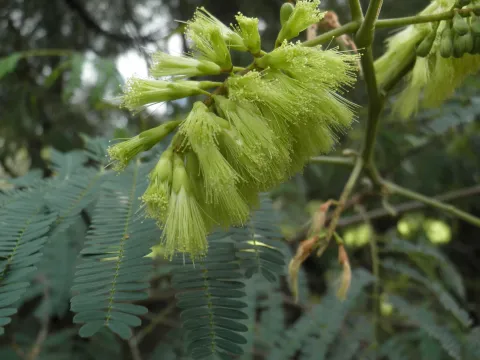
Paraserianthes
Paraserianthes
Propagation of Paraserianthes is primarily achieved through seeds. The seeds possess a hard seed coat, requiring scarification or a short soak in hot water to improve germination rates significantly.
What the section contains

Paraserianthes
Sowing in nurseries is performed in prepared substrates rich in organic matter with excellent drainage. The optimal time for establishing plantations is the onset of the rainy season, which ensures adequate moisture for the young seedlings to establish their root systems.
In natural conditions, the tree demonstrates a rapid growth rate, making it suitable for quick reforestation projects. It is crucial to provide shade for seedlings during the first few months after transplanting to protect them from harsh sunlight.
For industrial-scale cultivation, planting containerized seedlings is recommended, as the species is sensitive to root disturbance during handling and transport.
Planting density depends on the intended use: high density for reforestation or biomass production, and wider spacing (3-5 meters) when integrated into agroforestry systems alongside other crops.
Paraserianthes is a heat-loving culture belonging to the Fabaceae family, thriving in tropical and subtropical climates. The optimal temperature range for active vegetative growth is between 20 and 30 degrees Celsius.
The plant shows high adaptability to various soil types, including degraded or nutrient-poor soils. However, the best growth performance is observed in deep, well-drained, fertile loams with a neutral to slightly acidic pH.
The culture exhibits significant drought tolerance once its root system has penetrated deep into the soil profile. Nevertheless, consistent moisture during the growing season is essential to achieve maximum timber productivity.
The tree requires open, sunny locations for full canopy development. Excessive shading at later stages of life may lead to reduced photosynthetic efficiency and slower biomass accumulation.
A key biological feature is the ability of Paraserianthes to fix atmospheric nitrogen. Through symbiosis with root-nodule bacteria, the tree enhances soil fertility, making it a valuable component in sustainable agricultural ecosystems.
Paraserianthes is highly valued for its exceptionally fast biomass and timber growth rate. Under favorable conditions, the tree reaches harvestable trunk dimensions within 10–15 years, significantly faster than many traditional timber species.
Economic use includes the production of quality timber, which is suitable for furniture manufacturing, veneer production, and carpentry. The wood is characterized by moderate hardness and an attractive grain pattern.
In agroforestry, yields are measured not only by timber but also by the significant volume of green manure. The fallen leaves serve as an excellent source of nitrogen-rich organic matter for surrounding crops.
A byproduct of plantation management is the production of high-quality charcoal. This utilization stream provides additional economic viability for forestry operations.
The total yield of marketable timber per hectare depends heavily on initial planting density and silvicultural practices, such as sanitary pruning and thinning operations conducted during the first years of growth.
The primary threat to young Paraserianthes plantations is fungal root disease, often triggered by waterlogged soil conditions. Poor drainage promotes root rot, which can lead to rapid seedling mortality.
Pests such as leaf-eating insects and weevils can cause significant damage to foliage, thereby reducing the tree's growth rate. Regular monitoring of the canopy health is a standard protection procedure for plantations.
Wood-boring insects may attack the trunks of mature trees, reducing timber quality and making the tree susceptible to secondary infections. Both mechanical and chemical control measures are employed to mitigate these risks.
Weed competition is intense during the early years, threatening the growth of young saplings by competing for light and nutrients. Regular mowing or weeding of the root zones is necessary until canopy closure occurs.
Windthrow represents a significant risk in regions prone to tropical cyclones. To minimize potential losses, it is recommended to establish windbreaks consisting of more wind-resistant species along the plantation perimeter.