
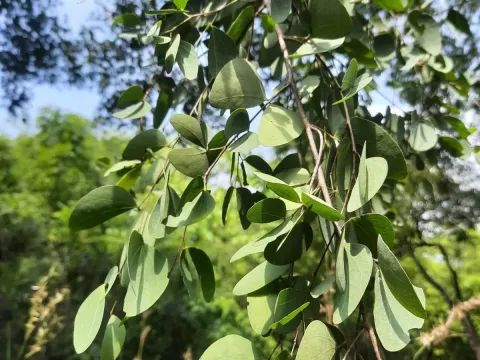
Hardwickia binata
Hardwickia
Propagation of Hardwickia binata in natural conditions occurs through seeds that mature within flat, leathery pods. For industrial cultivation, seeds are sown in nurseries or containers at the beginning of the rainy season to ensure optimal survival.
What the section contains

Hardwickia binata
Seeds exhibit high germination rates if harvested from mature trees and handled correctly. Pre-sowing treatments, such as soaking seeds in water for 12–24 hours, can significantly accelerate germination and uniformity of seedling emergence.
Seedlings are maintained in nurseries until they reach a height of 30–50 cm, typically requiring 6 to 12 months. Once established, they are ready for transplanting into the field, usually at the onset of monsoon rains.
Planting density depends on the intended use; reforestation projects usually employ a 2x2 meter spacing, while agroforestry systems require wider gaps to ensure sufficient sunlight for intercropped plants.
Young plants require consistent care during their first two years, including regular weeding around the base and protection from uncontrolled livestock grazing, which is a major threat in arid zones.
Hardwickia binata belongs to the Fabaceae family and is an extremely resilient tree, well-adapted to the arid tropical regions of India. It thrives in areas with annual rainfall ranging from 500 to 1200 mm.
The tree is highly light-demanding and does not tolerate shading during its early development stages. It shows remarkable adaptation to poor, rocky, and gravelly soils where other tree species struggle to grow.
Optimal soil pH levels for successful growth range from neutral to slightly alkaline. A critical condition for growth is well-draining soil, as the root system is sensitive to waterlogging and can quickly rot in swampy areas.
The plant demonstrates excellent heat tolerance, typical for dry zones, and is capable of shedding its leaves during extreme drought periods to conserve vital resources and survive harsh conditions.
A key biological feature is the ability of Hardwickia to fix atmospheric nitrogen in the soil through symbiosis with root-nodule bacteria, making it an invaluable asset for restoring degraded landscapes.
Hardwickia is primarily prized not for fruit production, but for its high-quality, exceptionally hard, and durable timber. The wood is widely used in construction, tool making, and agricultural implements.
The foliage of the tree is highly valued in agriculture as a nutritious fodder for sheep and goats, providing a critical food source during droughts when grasses and other forages are scarce.
In agroforestry, Hardwickia serves as an effective windbreak, significantly reducing soil erosion on open fields. Its deep root system helps stabilize slopes and improve soil structure over time.
Timber productivity depends on soil fertility and management practices, but in general, the species is known for its slow growth rate, which is offset by the longevity and immense density of the wood.
In addition to timber and fodder, the bark contains fibers suitable for making strong ropes and cordage, further increasing the economic diversity and utility of this agricultural crop.
Termites are the most significant pests for young Hardwickia crops, often causing damage to the roots and stems. Preventive soil treatment with appropriate insecticides prior to planting is recommended.
Young plants are also frequently targeted by rodents and wild ungulates, necessitating the use of mesh guards or natural barriers to protect the seedlings during their most vulnerable growth stages.
Root rot pathogens are a common threat, especially in areas with poor drainage or during prolonged periods of waterlogging. Fungal infections weaken the tree and degrade the long-term quality of the wood.
Leaf-eating insects and caterpillars may cause defoliation during outbreaks, though mature trees generally withstand such episodes well and are not typically at risk of mortality from these pests.
Maintaining sanitation in plantations by removing diseased or dead trees is essential to prevent the spread of infections and ensure the overall health of the forest stand.
Timber harvesting of Hardwickia binata is carried out once the tree reaches maturity, typically between 30 and 50 years. Due to the extreme hardness of the wood, specialized cutting equipment is required.
Fodder harvesting (lopping) can be conducted annually by pruning side branches. This practice not only provides farmers with a steady source of forage but also encourages the development of fresh, nutrient-rich shoots.
Adherence to proper pruning technology is vital; excessive removal of the crown must be avoided to prevent weakening the tree and to reduce the risk of secondary pathogen entry through large wounds.
Seed harvesting is performed after the pods have fully ripened and turned a deep brown color on the tree, signaling they are ready for collection and storage for future planting cycles.
After the final timber harvest, land management should prioritize natural regeneration or re-planting initiatives to maintain ecological balance and preserve the productive capacity of the site.