
Cylicodiscus
Cylicodiscus
Cylicodiscus (scientific name Cylicodiscus gabunensis) is a massive tropical tree species belonging to the legume family (Fabaceae), commonly traded under the name "Okan." This tree is endemic to the humid rainforest regions of West and Central Africa.
What the section contains

Cylicodiscus
The tree thrives in environments with high annual temperatures and substantial, consistent rainfall. It favors deep, nutrient-rich soils characteristic of tropical rainforests and is highly sensitive to prolonged periods of drought or excessive waterlogging.
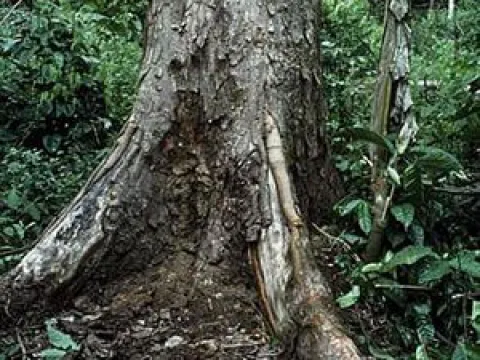
Botanically, it is an imposing tree that can reach heights of up to 60 meters with a trunk diameter of up to 3 meters. Young trees have smooth bark, which gradually develops a scaly, rough texture as the tree matures, serving as a key diagnostic feature.
Natural reproduction occurs via seeds, which are dispersed throughout the forest ecosystem. Cultivation of this species is uncommon due to its exceptionally slow growth rate, leading to a focus on sustainable forest management rather than traditional planting cycles.
The primary economic use of Cylicodiscus is its extremely dense and durable timber. It is highly valued for heavy-duty construction projects, including railway sleepers, bridge components, and industrial flooring that requires superior resistance to mechanical wear.
Yield in the context of forestry for Cylicodiscus is evaluated based on the cubic volume of timber harvested per hectare. Given the slow growth rate of this hardwood, the replenishment cycle for these resources spans many decades.
Mature trees offer a significant yield of high-quality logs, although the extreme density of the wood makes it challenging to process. Modern sawmills must utilize specialized heavy-duty machinery to cut and plane the timber effectively.
Standard agricultural yield metrics are not applicable to this species as it is not cultivated as a field crop. Nonetheless, its inherent resistance to biological decay and rot allows the tree to maintain its structural integrity for centuries.
Current research efforts are exploring ways to propagate the species, though these initiatives are constrained by the tree's complex symbiotic relationship with specific soil fungi required for optimal development in a tropical habitat.
Sustainable harvesting strategies are being implemented in the native range to balance the demand for high-grade Okan timber with the long-term conservation of the species within the remaining tropical forest ecosystems.