
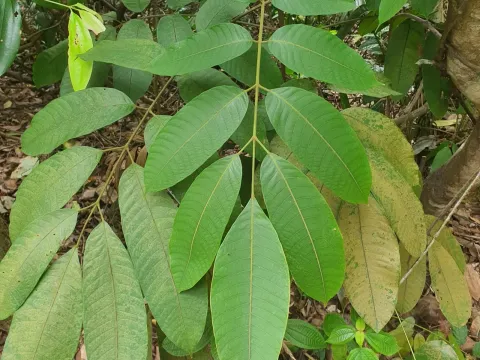
Santiria
Santiria
Santiria is a genus of evergreen trees belonging to the Burseraceae family. These plants are native to the tropical rainforests of Southeast Asia and Africa, where they thrive in warm, humid climates with stable environmental conditions throughout the year.
What the section contains


Santiria
For optimal growth, these trees require fertile, well-draining soils that provide ample nutrients and prevent waterlogging. Good drainage is essential, as the root systems of Santiria species are susceptible to damage from excessive soil moisture, which is common in low-lying tropical areas.
Climate requirements include high temperatures, ideally ranging between 24°C and 28°C. They are strictly tropical and cannot survive frost or significant cold stress, making their cultivation range geographically restricted to equatorial belts near the tropics.
The botanical structure of Santiria involves specialized resin ducts within the bark and wood. This physiological feature serves as a natural defense mechanism against herbivores and pathogens, contributing to the tree's resilience in the dense and competitive environment of a rainforest.
Cultivation practices for Santiria are largely focused on forestry and sustainable management of wild populations. Developing a systematic agricultural approach requires careful consideration of the long growth cycle and the complex interactions within the tropical ecosystem where these trees naturally occur.
The primary economic use of Santiria is the exploitation of its high-quality timber. The wood is valued in the furniture industry and for architectural construction due to its durability, workability, and distinct aesthetic qualities that make it suitable for decorative purposes.
Beyond timber, Santiria trees are valued for their resins and fruits, which are used in local traditional medicine and the production of specialty oils. These products highlight the potential of the genus for non-timber forest product development in tropical regions.
Harvesting timber requires careful forest management to ensure that tree populations remain sustainable. Mature trees are selected based on size and health criteria, ensuring that logging activities do not negatively impact the surrounding flora and fauna within the forest ecosystem.
Fruit harvesting is typically done by hand, especially in areas where traditional practices prevail. Given the height of these trees, manual collection can be labor-intensive, requiring precise timing to catch the fruit when it has reached its full maturity and chemical ripeness.
Post-harvest handling is critical, particularly for fruits, which are highly perishable. Proper drying and processing techniques are required to stabilize the chemical components and prepare the materials for market distribution or further industrial refinement.