
Santiria laevigata
Santiria laevigata
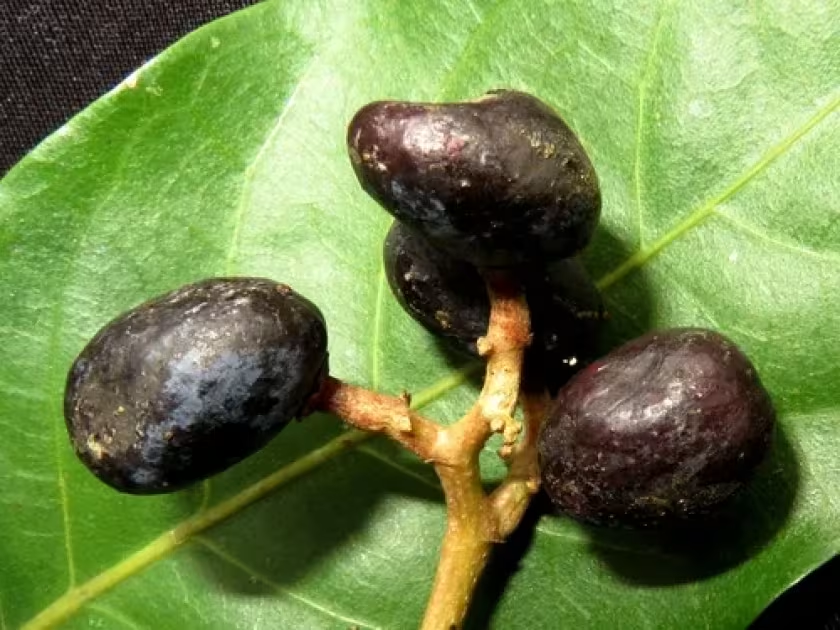
Description
Growing requirements
Santiria laevigata is a prominent evergreen tree species belonging to the Burseraceae family. It serves as a vital component of the lowland tropical rainforest ecosystems found throughout Southeast Asia.
The native range of this species encompasses countries such as Malaysia, Indonesia, and the Philippines. These regions provide the stable, hot, and humid conditions necessary for the tree to complete its life cycle and reach maturity.
The plant thrives in well-drained, nutrient-rich soils common in tropical rainforests. It exhibits a deep root system that anchors the tree firmly and facilitates the uptake of essential nutrients in competitive forest environments.
Environmental conditions require an equatorial climate with minimal seasonal temperature variation. The species relies on high levels of atmospheric moisture and consistent annual rainfall to maintain its metabolic processes.
Regarding light requirements, Santiria laevigata shows ontogenetic changes. While saplings are shade-tolerant, mature trees become dominant canopy components, requiring significant solar radiation to support rapid biomass production.
Harvesting
The primary economic value of Santiria laevigata lies in its high-quality timber. The wood is prized for its uniform texture and strength, making it suitable for both architectural joinery and furniture construction.
In the timber industry, the logs are processed into planks that are valued for their stability and ease of working. Proper seasoning is critical to ensuring the structural integrity of the final products derived from this species.
Sustainable logging practices are strictly implemented to maintain forest health. Forestry management focuses on selective harvesting to ensure the survival of younger cohorts and the overall biodiversity of the tropical landscape.
Research into the chemical properties of the species has revealed the presence of specific resins and oils. While these are often secondary to the timber value, they represent a significant area of interest for ethnobotanical studies.
Ongoing monitoring of population density is part of the agricultural and forestry strategy for this species. This ensures that current extraction levels do not exceed the natural regenerative capacity of the forest stands.