
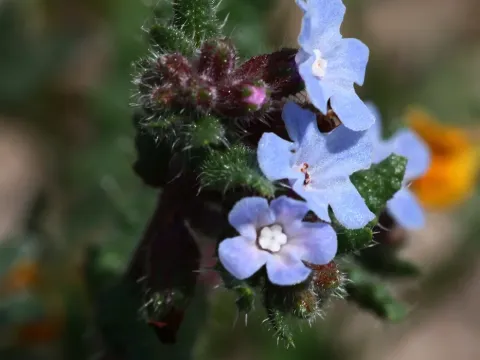
Anchusa
Anchusa
Anchusa seeds are sown directly into the open ground during the spring season, typically from April to May, once the soil has warmed up sufficiently.
What the section contains
 Anchusa incana
 Ledeb.
Anchusa incana
Anchusa incana Ledeb.
 Cape alkanet
Anchusa capensis Thunb.
Cape alkanet
Anchusa capensis Thunb.
 Common bugloss
Anchusa officinalis L.
Common bugloss
Anchusa officinalis L.
 Field borage
Anchusa arvensis (L.) M. Bieb.
Field borage
Anchusa arvensis (L.) M. Bieb.
 Italian bugloss
Anchusa azurea Mill.
Italian bugloss
Anchusa azurea Mill.
 Narrow-leaved alkanet
Anchusa leptophylla Roem. & Schult.
Narrow-leaved alkanet
Anchusa angustissima K. Koch
Narrow-leaved alkanet
Anchusa leptophylla Roem. & Schult.
Narrow-leaved alkanet
Anchusa angustissima K. Koch
Anchusa
Fall sowing is another viable option, performed in October or November, which allows the seeds to undergo natural stratification for improved germination rates.
For earlier flower development, the plant can be grown using the transplanting method, starting seeds in containers indoors throughout March.
It is recommended to plant the seeds at a depth of 1 to 2 centimeters to ensure they are adequately covered while remaining close enough to the surface to sprout effectively.
When sowing in rows, a space of 30 to 40 centimeters should be maintained between the rows, while thinning seedlings ensures a distance of 20 to 30 centimeters between plants.
Anchusa belongs to the Boraginaceae family, featuring unique botanical traits that make it a highly resilient and attractive plant for various agricultural settings.
Native to regions across the Mediterranean and Europe, it thrives in climates that offer plenty of direct sunlight and well-drained, lime-rich soil conditions.
The crop requires minimal irrigation but must be protected from waterlogged soils, as excessive moisture often causes irreparable damage to the root system.
In terms of agricultural management, regular weeding and periodic loosening of the topsoil are necessary to facilitate gas exchange and nutrient absorption.
Anchusa is primarily utilized as an ornamental plant and a significant honey-producing crop due to its ability to attract pollinators to the field throughout the summer.
Excessive humidity remains the primary threat to the health of Anchusa, frequently leading to root rot that can quickly decimate entire patches of the crop.
In conditions with poor ventilation or high density, powdery mildew often becomes a problem, requiring the use of fungicides to manage the fungal spread.
Aphids are the most common pests found on the plant, as they tend to congregate on young shoots and buds, significantly stunting the growth of the crop.
Various larvae can also cause damage by feeding on leaves or roots, which necessitates routine field monitoring and the use of targeted pest control measures.
Maintaining proper spacing between plants is an essential strategy for preventing the onset of disease, as it ensures adequate airflow and reduces moisture buildup.