
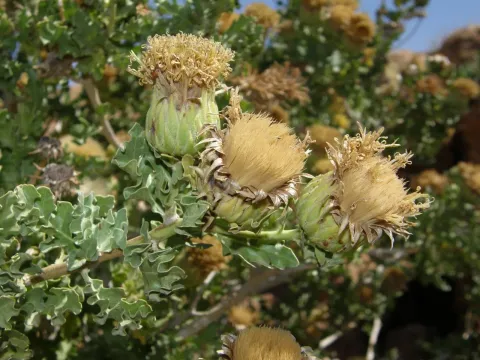
Warionia
Warionia
Warionia (Warionia saharae) is an endemic Saharan plant that requires careful propagation management due to its naturally low germination rates. When cultivating this species, stratification or the use of growth regulators is often recommended to improve success rates.
What the section contains

Warionia
The ideal sowing time is early spring, ensuring soil temperatures stay consistently between +15 and +22 degrees Celsius. Seeds should be sown in lightweight, sandy, well-draining substrates to prevent potential seed rot and ensure proper oxygen exchange.
Seeds should be covered only very lightly with soil, as they require a certain amount of light for activation. Maintaining moderate soil moisture without saturation is crucial during the initial stages of seedling development, which can be quite slow.
Vegetative propagation via cuttings is a more reliable method for commercial production. Cuttings taken from semi-woody stems should be rooted under controlled greenhouse conditions with consistent humidity to ensure root initiation.
Young plants require several months of hardening off before they can be transitioned to an open-field setting. During this phase, it is vital to protect the plants from harsh winds and direct scorching heat while gradually adjusting them to full solar radiation.
As a member of the Asteraceae family adapted to the extreme arid environments of Morocco and Algeria, Warionia thrives in harsh, high-UV conditions. It is a xerophytic species that has evolved to withstand long periods of drought.
Light is the most critical factor for the development of the plant's unique chemical profile. Warionia requires full, unobstructed sun exposure throughout the day to accumulate the high levels of sesquiterpene lactones that make it commercially valuable.
The soil must be well-draining, preferably alkaline, rocky, or sandy in texture. Heavy, clay-rich soils are entirely unsuitable as they impede root aeration and quickly lead to plant mortality caused by root diseases.
The plant is highly drought-tolerant, utilizing its deep root system to access subterranean moisture. In agricultural practice, irrigation should be minimal and focused on preventing total desiccation rather than stimulating lush vegetative growth.
Maintaining a neutral to slightly alkaline soil pH is essential for optimal nutrient uptake. Due to its adaptation to nutrient-poor soils, the plant does not require heavy fertilization; excess nitrogen may actually decrease the quality of its secondary metabolites.
The economic value of Warionia lies primarily in its foliage and flower heads, which are used in traditional medicine and the extraction of bioactive compounds. The annual yield is heavily dependent on the age of the shrubs and local climatic conditions.
Harvesting should be performed selectively, ensuring that the main structural stems are preserved to allow for regeneration. Systematic pruning is a recommended practice to stimulate new branching and increase the total leaf surface area for subsequent harvests.
While large-scale cultivation is still emerging, the demand for this plant in the pharmaceutical industry remains stable. Efficiency in yield is optimized by maintaining uniform spacing between plants to ensure that every specimen receives maximum light.
Product quality is assessed by the concentration of volatile oils and lactones. Studies indicate that plants grown at higher altitudes with more intense solar radiation produce a higher concentration of these therapeutic compounds.
As a perennial semi-shrub, a well-managed plantation can remain productive for several years. Labor-intensive manual harvesting remains the standard method, as mechanization can easily damage the delicate, high-value components of the plant.
Warionia’s primary enemies are soil-borne pathogens, particularly fungi such as Fusarium and Phytophthora. These threats are almost exclusively triggered by overwatering, poor drainage, or an overly humid microclimate around the roots.
While the plant’s strong bitter taste and aromatic profile make it resistant to many herbivores, it is not immune to all pests. In high-stress environments, spider mites or aphids may attempt to feed on young, succulent tissue, requiring immediate attention.
Weed management is critical during the plant’s early life stages. Because Warionia grows relatively slowly from seed, early competition with invasive weeds can stunt its development and lead to poor establishment of the plantation.
Environmental stress, such as unseasonal frosts or prolonged cold snaps, can weaken the plant's resistance, making it more susceptible to opportunistic infections. Monitoring the plant's health status is essential during temperature fluctuations.
The most effective strategy against threats is prevention through structural management: choosing the right soil type, installing efficient drainage systems, and practicing precise irrigation. Chemical intervention should always be a secondary, last-resort measure.