
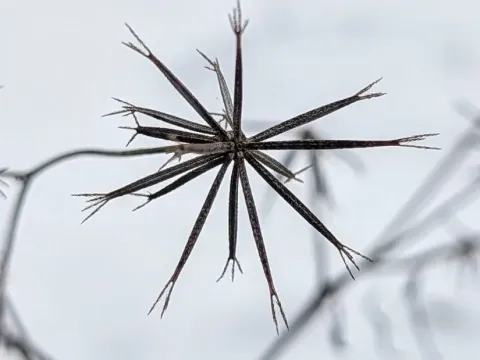
Spanish needle
Bidens bipinnata
Spanish needle (Bidens bipinnata) is a member of the Asteraceae family. It is a widespread annual herb that is frequently categorized as a problematic weed in various agricultural production systems across the world.
What the section contains
Spanish needle
The germination of seeds typically occurs in late spring when soil temperatures reach 12–15 degrees Celsius. In many agricultural regions, this coincides with the planting period for summer annual crops.
Reproduction is facilitated by specialized awns on the seeds equipped with barbs. These appendages attach easily to surfaces, allowing for efficient transport via machinery, animals, and agricultural equipment.
Seeds demonstrate remarkable longevity in the soil seed bank, remaining viable for several years. This persistence necessitates a consistent weed management program to prevent severe infestations over multiple growing seasons.
Biological vigor in the early vegetative stage allows the species to compete effectively for nitrogen and water, often outcompeting crop seedlings during critical periods of canopy establishment.
Spanish needle thrives in sunny environments with moderate to high soil moisture levels. It shows a strong preference for nutrient-rich soils, making it an aggressive competitor in vegetable and field crop production.
The plant exhibits high temperature tolerance and performs best during hot summer months. Its robust root system allows it to access deeper soil moisture layers, which enhances its survival during dry spells.
Agronomic control is highly dependent on mechanical soil cultivation. Proper tilling and inter-row cultivation are effective in removing young seedlings before they develop a deep taproot structure.
While adaptable to various pH levels, the plant prefers loose, well-aerated soils. Soil compaction can sometimes limit its spread, though it often colonizes disturbed sites with ease.
Effective management also involves the timely application of herbicides. Pre-emergent and post-emergent options should be selected based on the specific crop safety profile and the developmental stage of the weed.
Spanish needle acts as a host for various agricultural pathogens. It can harbor viruses that are subsequently transmitted by insect vectors to surrounding vegetable or grain crops, potentially reducing overall yields.
Insects such as aphids and plant bugs frequently colonize the plant. These pests can serve as a bridge, moving from the weed to cultivated crops, thereby increasing the economic damage to the harvest.
Fungal diseases, including various leaf spots and powdery mildew, may develop during periods of high humidity. While the weed remains vigorous, these pathogens create an inoculum pressure on the farm.
Root-knot nematodes and other soil-borne organisms may utilize the roots of the plant for survival, complicating long-term soil health management for subsequent crop rotations.
Integrated Pest Management (IPM) strategies are essential to mitigate the threats posed by this species, emphasizing the importance of keeping field margins and fallow lands clean.