
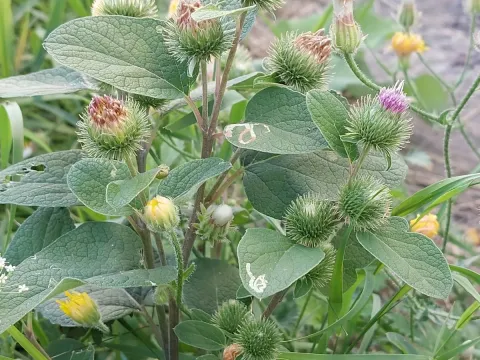
Hybrid burdock
Arctium nothum
The sowing of hybrid burdock Arctium nothum is typically performed in late autumn or early spring immediately after the snow melts. Since the seeds require cold stratification to break dormancy, late autumn sowing is generally considered the most effective method for successful germination.
What the section contains
Hybrid burdock
Seeds are sown at a depth of 2 to 3 centimeters depending on the soil type. Row spacing should be maintained at 60–70 centimeters to allow enough space for the development of the large leaf rosette, which is vital for the plant's photosynthetic capacity.
Consistent soil moisture is crucial during the germination phase. While seedlings begin to emerge at temperatures around +8 degrees Celsius, vigorous growth is only observed when the soil temperature consistently reaches +18–20 degrees Celsius.
The seeding rate is approximately 3 to 5 kilograms per hectare, depending on seed quality and soil preparation. Overcrowding in rows results in smaller, lower-quality taproots, which makes proper thinning an essential agronomic task.
Once two true leaves have developed, plants should be thinned to a spacing of 30–40 centimeters between individuals. This ensures that every plant has adequate access to nutrients and light, promoting the development of a large, high-quality taproot.
Hybrid burdock is a member of the Asteraceae family and requires open, sunny locations for optimal development. Shaded areas lead to spindly growth and a significant reduction in the accumulation of biological compounds within the roots.
The crop thrives in fertile, deep, loamy or sandy soils with a neutral to slightly alkaline pH. Because the plant produces a long taproot, deep plowing to a depth of at least 30–40 centimeters is necessary to prevent root malformation.
Good soil aeration and drainage are vital, as hybrid burdock is sensitive to waterlogging. Excessive moisture in the soil can trigger root rot diseases, which often result in total crop loss if not managed through proper site selection.
While the plant exhibits high drought resistance, consistent irrigation during the peak growing phase significantly increases final yield. Incorporating organic matter, such as compost or well-rotted manure, during autumn tillage provides long-term nutrient availability.
A structured crop rotation is recommended to maintain soil health and reduce the risk of soil-borne pathogens. Replanting burdock on the same field should be avoided for at least four years to keep the soil environment productive and clean.
The productivity of hybrid burdock is measured by the total mass of harvested roots per unit area. Under optimal agronomic conditions, dry root yields can range from 20 to 30 centners per hectare, depending on soil quality.
The accumulation of inulin, a key polysaccharide in burdock, peaks at the end of the first year of growth. Harvesting at the correct stage is essential for meeting industry standards for pharmaceutical-grade raw materials.
Root size is highly dependent on site fertility and even moisture distribution throughout the summer. Proper management allows roots to reach lengths of 40–60 centimeters and diameters of up to 5 centimeters at the top.
Post-harvest processing includes cleaning and rapid drying to ensure the preservation of bioactive compounds. The final dry product typically yields about 25–30% of the weight of the freshly harvested raw roots.
Continuous monitoring of the plantation allows for timely interventions that protect the crop's health. Maintaining a robust stand ensures that the harvested roots meet all quality requirements for further processing.
Powdery mildew is the most frequent fungal issue affecting burdock, characterized by a white powdery coating on the leaves. It spreads quickly in humid conditions and dense canopies, necessitating proper spacing and air circulation.
Root rot is a major threat, usually caused by poor soil drainage or the use of improper organic fertilizers. This condition causes the roots to darken and decay, making the entire harvest unfit for commercial or medicinal use.
Leaf-eating insects, such as beetles and caterpillars, may occasionally infest the foliage. While burdock is generally hardy, severe defoliation can hinder the plant's ability to store sufficient nutrients in its root system.
Aphids can colonize the young shoots, leading to stunted growth. Biological control methods or mechanical removal are usually preferred to keep the raw material free of pesticide residues, which is crucial for medicinal crops.
Good weed management is essential, as many weeds act as alternative hosts for diseases and pests. A clean field and early detection of symptoms are the most effective ways to ensure a successful growing season.
Harvesting hybrid burdock takes place in the autumn of the first year, once the above-ground foliage begins to wither. This timing ensures that the roots are fully developed and rich in stored carbohydrates.
Mechanized lifting using specialized equipment is recommended to reach the depth of the taproots. Care must be taken during the process to keep the roots intact, as breaks result in the loss of valuable plant fluids.
After excavation, the roots must be thoroughly washed in cold water to remove soil and lateral rootlets. They are then chopped into manageable segments to facilitate efficient drying in controlled environments.
Drying is performed in ventilated rooms or commercial dryers at temperatures between 40 and 50 degrees Celsius. This temperature range preserves the chemical profile of the roots while preventing spoilage.
Once dried, the product should be stored in paper bags within a dry, cool, and airy facility. High-quality dry burdock root can be stored for up to three years while maintaining its potency for various herbal applications.