
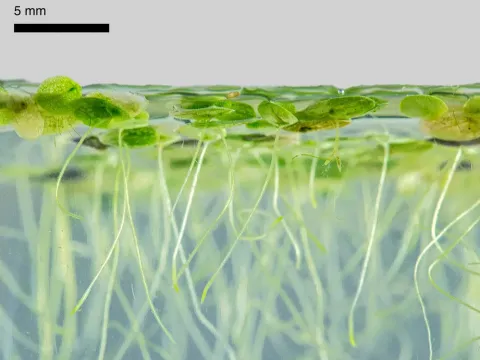
Duckweed
Lemna L.
Duckweed does not require traditional seeding, as its propagation is based on the rapid vegetative division of thalli. In an agricultural context, the establishment phase starts in spring when water temperatures consistently exceed 10–12°C.
What the section contains

Duckweed
To initiate a commercial crop, seed material is distributed evenly across the water surface. A starting density covering 5-10% of the area is generally sufficient to trigger exponential growth, allowing the culture to cover the entire surface within a few weeks.
The plant exhibits remarkable growth rates, doubling its biomass every 2 to 4 days under optimal conditions. This high reproductive capacity eliminates the need for frequent replanting, making it a self-sustaining system throughout the warm season.
Water movement should be managed to avoid strong currents that can damage the delicate thalli. Controlled ponds or basins with regulated water flow are preferred to maintain a consistent mat density and facilitate easier management of the crop.
Regular monitoring is recommended every 7-10 days to check for uniform distribution and to perform partial harvesting, which keeps the population in a vigorous growth phase and prevents overcrowding.
Duckweed, belonging to the Lemnaceae family, is highly productive but sensitive to its chemical environment. An optimal pH range of 6.0–7.5 is preferred, and the plant thrives in nutrient-rich water, effectively absorbing excess nitrogen and phosphorus.
Temperature is the primary driver of growth, with the most active biomass accumulation occurring between 20°C and 30°C. Below 6°C, metabolic processes stall, and the plant may enter a dormant state, sinking as turions to the bottom of the pond to survive winter conditions.
Light availability is critical, as duckweed requires significant solar energy for photosynthesis. Well-lit, open-air environments are ideal, while heavy shading should be avoided to prevent declines in yield and stunted development of the thalli.
Although it does not grow in soil, the quality of bottom sediments affects the mineral concentration in the water. High organic content in the pond bed provides a steady supply of micronutrients, supporting sustained growth throughout the summer.
The culture is sensitive to industrial pollutants and heavy metals, which it bioaccumulates. Therefore, water quality must be strictly monitored to ensure the final biomass is safe for livestock consumption and does not contain toxic residues.
Duckweed offers one of the highest yields among forage crops, producing up to 10–30 metric tons of dry matter per hectare per season. This productivity significantly outperforms many traditional land-based grasses and forage legumes.
Yield levels are directly proportional to nutrient availability in the water. Targeted fertilization using organic effluents or mineral solutions can maintain peak growth rates and maximize the protein content of the harvested biomass.
In intensive controlled environments, such as vertical aquaculture systems, yields can be further optimized by regulating carbon dioxide levels and lighting intensity. These systems allow for year-round production of high-protein biomass.
Frequent harvesting is essential to maintain high yield levels. By removing a portion of the mat regularly, producers prevent the "aging" of the colony, which can lead to decay and a decrease in overall production quality.
The harvest efficiency depends on maintaining a specific mat thickness. Ideally, the plants should be harvested just as they fully cover the surface to ensure the highest concentration of biomass per square meter of water surface.
While duckweed is resilient, it can be susceptible to fungal infections, particularly when excessive humidity and poor air circulation occur above the water surface. Mold development is a common issue in overly dense, stagnant mats.
Pests such as aquatic larvae and specific mollusks can cause physical damage to the thalli. However, due to the plant's rapid regeneration rate, such infestations are rarely fatal and usually only result in temporary yield fluctuations.
Competition from other aquatic plants like coontail or elodea can significantly reduce duckweed productivity. Regular maintenance of the pond to remove invasive aquatic weeds is necessary to ensure the dominance of the target crop.
Algal blooms, especially those involving cyanobacteria, can create toxic conditions that inhibit duckweed growth. Managing nutrient levels to prevent eutrophication and maintaining proper water flow are key control strategies.
Extreme weather, such as high winds, can cause the plants to pile up on shorelines, leading to dehydration or rot. Using floating barriers or wind-sheltered locations helps protect the crop from environmental physical stress.
Harvesting is typically performed using mechanical systems such as nets, conveyor belts, or filtration skimmers. These methods are designed to efficiently collect the biomass without damaging the fragile thalli of the duckweed.
The optimal harvest time is early morning, when plants are most turgid and contain the highest concentration of nutrients. After collection, the biomass must be rinsed to remove sediment and debris to ensure a clean product.
For storage and processing, drying or ensiling are standard practices. Low-temperature drying is preferred to preserve the integrity of the amino acids and the essential vitamin profile that makes duckweed an excellent feed additive.
Freshly harvested duckweed is highly palatable for poultry and fish. It is often shredded or mixed with other feed ingredients to balance the diet, ensuring optimal nutrient intake and digestibility for livestock.
In industrial production, continuous harvesting is necessary to prevent the mat from becoming too thick, which would reduce oxygen levels in the water and negatively impact both the water quality and the nutritional value of the harvest.